


Page 66 - (DK) Home Doctor: Providing practical advice on home treatments
P. 66
64   COMMON CONDITIONS: EYE AND EAR PROBLEMS

         Earache


              Pain in one or both ears and temporary hearing loss are often caused by a middle-ear infection, in which
              case you may also have a fever and feel generally ill. Sometimes, the eardrum bursts as a result of
              increased pressure and there is a discharge from the ear. An earache can also be caused by infection in
              the outer ear (swimmer’s ear) or be associated with a throat or sinus infection or a tooth problem. You may
              also get a mild earache because of a buildup of mucus in your ear after a cold; during an attack of hay fever;
              or from pressure changes in the ear if you travel by plane or go diving.
              See also Swimmer’s ear, opposite page; Popping ears, p.66; Sinusitis, p.79; Earache (children), p.140.


              See your doctor first
                                                                    DRUG REMEDIES
              Make an appointment to see your doctor if:
              ● You have a severe earache, develop a fever,  Analgesics Acetaminophen (see p.177) and
                                                            ibuprofen (see p.185) will reduce discomfort, and
              or have a discharge from your ear
                                                            will also reduce fever if you have an ear infection.
                                                            Decongestants (see p.181) in the form
                                                            of nasal sprays or drops can help clear congestion
         What you can do yourself                           in the nose, sinuses, and middle ear when you have
              While following your doctor’s advice, there are  a cold or allergy. Don’t use a decongestant for more
              several measures you can take to relieve an   than 7 days continuously. If you use one for longer
                                                            you may have a “rebound effect,” with symptoms
              earache or to treat a mild earache yourself.
                                                            returning when you stop taking the drug.
              ● Take analgesics to reduce the discomfort
              (see DRUG REMEDIES, right).
              ● Sleep with your head raised on several pillows
                                                                PRACTICAL TECHNIQUE
              to reduce pressure in the middle ear.
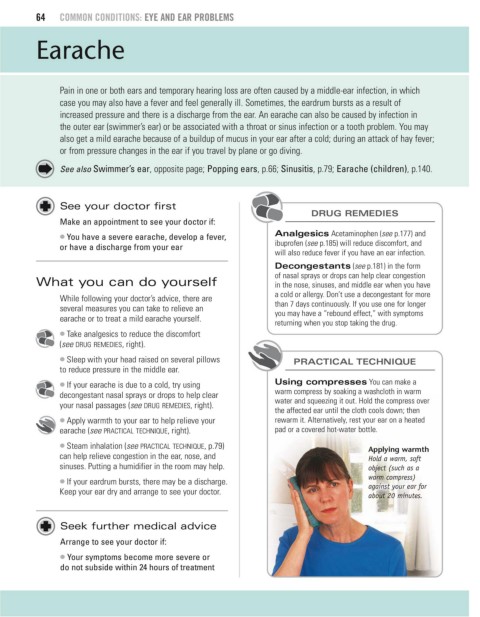
              ● If your earache is due to a cold, try using  Using compresses You can make a
                                                            warm compress by soaking a washcloth in warm
              decongestant nasal sprays or drops to help clear
              your nasal passages (see DRUG REMEDIES, right).  water and squeezing it out. Hold the compress over
                                                            the affected ear until the cloth cools down; then
              ● Apply warmth to your ear to help relieve your  rewarm it. Alternatively, rest your ear on a heated
              earache (see PRACTICAL TECHNIQUE, right).     pad or a covered hot-water bottle.
              ● Steam inhalation (see PRACTICAL TECHNIQUE, p.79)
                                                                                 Applying warmth
              can help relieve congestion in the ear, nose, and                  Hold a warm, soft
              sinuses. Putting a humidifier in the room may help.                object (such as a
                                                                                 warm compress)
              ● If your eardrum bursts, there may be a discharge.
                                                                                 against your ear for
              Keep your ear dry and arrange to see your doctor.
                                                                                 about 20 minutes.
              Seek further medical advice

              Arrange to see your doctor if:
              ● Your symptoms become more severe or
              do not subside within 24 hours of treatment

