


Page 139 - (DK Eyewitness) Travel Guide - Rome
P. 139
PIAZZA DI SP A GNA 137
a French monarch in the papal
city, and the arguments
continued until the 1720s when
an Italian architect, Francesco
de Sanctis, produced a design
that satisfied both parties. The
steps, completed in 1726,
combine straight sections,
curves, and terraces to create
one of the city’s most dramatic
and distinctive landmarks.
When the Victorian novelist
Charles Dickens visited Rome, he
reported that the Spanish Steps
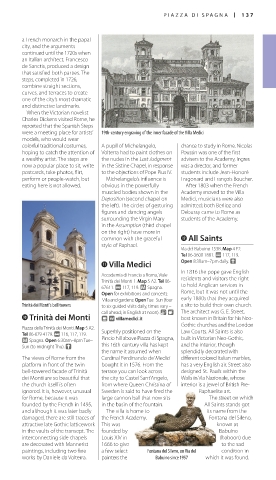
were a meeting place for artists’ 19th-century engraving of the inner facade of the Villa Medici
models, who would wear
colorful traditional costumes, A pupil of Michelangelo, chance to study in Rome. Nicolas
hoping to catch the attention of Volterra had to paint clothes on Poussin was one of the first
a wealthy artist. The steps are the nudes in the Last Judgment advisers to the Academy, Ingres
now a popular place to sit, write in the Sistine Chapel, in response was a director, and former
postcards, take photos, flirt, to the objections of Pope Pius IV. students include Jean-Honoré
perform or people-watch, but Michelangelo’s influence is Fragonard and François Boucher.
eating here is not allowed. obvious in the powerfully After 1803 when the French
muscled bodies shown in the Academy moved to the Villa
Deposition (second chapel on Medici, musicians were also
the left). The circles of gesturing admitted; both Berlioz and
figures and dancing angels Debussy came to Rome as
surrounding the Virgin Mary students of the Academy.
in the Assumption (third chapel
on the right) have more in
common with the graceful w All Saints
style of Raphael.
Via del Babuino 153B. Map 4 F2.
Tel 06-3600 1881. @ 117, 119.
q Villa Medici Open 8:30am–7pm daily. 5
In 1816 the pope gave English
Accademia di Francia a Roma, Viale
Trinità dei Monti 1. Map 5 A2. Tel 06- residents and visitors the right
67611. @ 117, 119. q Spagna. to hold Anglican services in
Open for exhibitions and concerts. Rome, but it was not until the
Villa and gardens: Open Tue–Sun (four early 1880s that they acquired
Trinità dei Monti’s bell towers to six guided visits daily, times vary – a site to build their own church.
call ahead; in English at noon). & 8 The architect was G. E. Street,
0 Trinità dei Monti - ∑ villamedici.it best known in Britain for his Neo-
Gothic churches and the London
Piazza della Trinità dei Monti. Map 5 A2.
Tel 06-679 4179. @ 116, 117, 119. Superbly positioned on the Law Courts. All Saints is also
q Spagna. Open 6:30am–8pm Tue– Pincio hill above Piazza di Spagna, built in Victorian Neo-Gothic,
Sun (to midnight Thu). 5 this 16th-century villa has kept and the interior, though
the name it assumed when splendidly decorated with
The views of Rome from the Cardinal Ferdinando de’ Medici different colored Italian marbles,
platform in front of the twin bought it in 1576. From the has a very English air. Street also
bell-towered facade of Trinità terrace you can look across designed St.-Paul’s-within-the-
dei Monti are so beautiful that the city to Castel Sant’Angelo, Walls in Via Nazionale, whose
the church itself is often from where Queen Christina of interior is a jewel of British Pre-
ignored. It is, however, unusual Sweden is said to have fired the Raphaelite art.
for Rome, because it was large cannon ball that now sits The street on which
founded by the French in 1495, in the basin of the fountain. All Saints stands got
and although it was later badly The villa is home to its name from the
damaged, there are still traces of the French Academy. Fontana del Sileno,
attractive late Gothic latticework This was known as
in the vaults of the transept. The founded by Babuino
interconnecting side chapels Louis XIV in (baboon) due
are decorated with Mannerist 1666 to give to the sad
paintings, including two fine a few select Fontana del Sileno, on Via del condition in
works by Daniele da Volterra. painters the Babuino since 1957 which it was found.
136-137_EW_Rome_US.indd 137 15/03/17 3:48 pm

