


Page 222 - (DK Eyewitness) Travel Guide - Rome
P. 222
220 ROME AREA B Y AREA
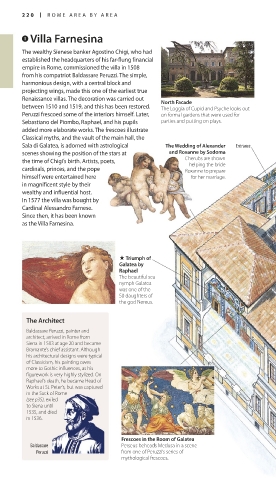
1 Villa Farnesina
The wealthy Sienese banker Agostino Chigi, who had
established the headquarters of his far-flung financial
empire in Rome, commissioned the villa in 1508
from his compatriot Baldassare Peruzzi. The simple,
harmonious design, with a central block and
projecting wings, made this one of the earliest true
Renaissance villas. The decoration was carried out North Facade
between 1510 and 1519, and this has been restored. The Loggia of Cupid and Psyche looks out
Peruzzi frescoed some of the interiors himself. Later, on formal gardens that were used for
Sebastiano del Piombo, Raphael, and his pupils parties and putting on plays.
added more elaborate works. The frescoes illustrate
Classical myths, and the vault of the main hall, the
Sala di Galatea, is adorned with astrological The Wedding of Alexander Entrance
scenes showing the position of the stars at and Roxanne by Sodoma
the time of Chigi’s birth. Artists, poets, Cherubs are shown
helping the bride
cardinals, princes, and the pope Roxanne to prepare
himself were entertained here for her marriage.
in magnificent style by their
wealthy and influential host.
In 1577 the villa was bought by
Cardinal Alessandro Farnese.
Since then, it has been known
as the Villa Farnesina.
. Triumph of
Galatea by
Raphael
The beautiful sea
nymph Galatea
was one of the
50 daughters of
the god Nereus.
The Architect
Baldassare Peruzzi, painter and
architect, arrived in Rome from
Siena in 1503 at age 20 and became
Bramante’s chief assistant. Although
his architectural designs were typical
of Classicism, his painting owes
more to Gothic influences, as his
figurework is very highly stylized. On
Raphael’s death, he became Head of
Works at St. Peter’s, but was captured
in the Sack of Rome
(see p35), exiled
to Siena until
1535, and died
in 1536.
Frescoes in the Room of Galatea
Baldassare Perseus beheads Medusa in a scene
Peruzzi from one of Peruzzi’s series of
mythological frescoes.
US_220-221_EW_Rome_US.indd 220 15/03/17 3:53 pm

