


Page 225 - (DK Eyewitness) Travel Guide - Rome
P. 225
JANICUL UM 223
Vatican. Two wide chapels, Renaissance dream that
one on either side of the nave, the city of Rome would
were decorated by some of once again relive its
Michelangelo’s most famous ancient glory.
pupils. The left-hand chapel
was designed by one of the
few artists Michelangelo
openly admired, Daniele da
Volterra, also responsible for
the altar painting, The Baptism
of Christ. The chapel on the
right was the work of Giorgio
Courtyard of Sant’Onofrio Vasari, who included a self-
portrait (in black, on the left)
6 Sant’Onofrio in his altar painting, The
Conversion of St. Paul.
Piazza di Sant’Onofrio 2. Map 3 C4.
Tel 06-686 4498. @ 870. Open The first chapel to the right
9am–1pm Sun–Fri. Closed Aug. 5 of the entrance contains a Fontana dell’Acqua Paola
Museum: Open by appt only (call powerful Flagellation, by the
06-686 9040). Venetian artist Sebastiano del 9 Fontana
Piombo (1518); Michelangelo dell’Acqua Paola
Beato Nicola da Forca Palena, is said to have provided the
whose tombstone guards the original drawings. Work by Via Garibaldi. Map 7 B1.
entrance, founded this church Bernini and his followers can @ 44, 75.
in 1419 in honor of the hermit be seen in the second chapel
St. Onofrio. It retains the flavor on the left and in the flanking This monumental fountain
of the 15th century in the De Raymondi tombs. commemorates the reopening
simple shapes of the portico in 1612 of an aqueduct
and the cloister. In the early originally built by Emperor
17th century the portico was 8 Tempietto Trajan in AD 109. The aqueduct
decorated with frescoes Piazza San Pietro in Montorio (in was renamed the “Acqua Paola”
by Domenichino. court yard). Map 7 B1. Tel 06-581 2806. after Paul V, the Borghese pope
The monastery next to the @ 44, 75. Open 10am–6pm Tue–Sun. who ordered its restoration.
church houses a small museum See The History of Rome pp34–5. When it was first built, the
dedicated to the 16th-century fountain had five small basins,
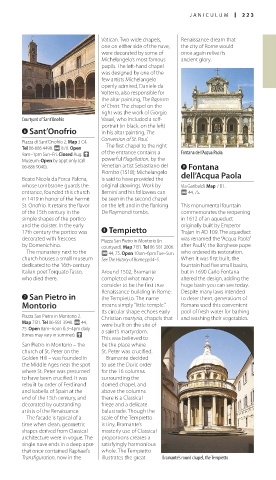
Italian poet Torquato Tasso, Around 1502, Bramante but in 1690 Carlo Fontana
who died there. completed what many altered the design, adding the
consider to be the first true huge basin you can see today.
Renaissance building in Rome: Despite many laws intended
7 San Pietro in the Tempietto. The name to deter them, generations of
Montorio means simply “little temple.” Romans used this convenient
Its circular shape echoes early pool of fresh water for bathing
Piazza San Pietro in Montorio 2. Christian martyria, chapels that and washing their vegetables.
Map 7 B1. Tel 06-581 3940. @ 44, were built on the site of
75. Open 8am–noon & 3–4pm daily a saint’s martyrdom.
(times may vary in summer). 5
This was believed to
San Pietro in Montorio – the be the place where
church of St. Peter on the St. Peter was crucified.
Golden Hill – was founded in Bramante decided
the Middle Ages near the spot to use the Doric order
where St. Peter was presumed for the 16 columns
to have been crucified. It was surrounding the
rebuilt by order of Ferdinand domed chapel, and
and Isabella of Spain at the above the columns
end of the 15th century, and there is a Classical
decorated by outstanding frieze and a delicate
artists of the Renaissance. balustrade. Though the
The facade is typical of a scale of the Tempietto
time when clean, geometric is tiny, Bramante’s
shapes derived from Classical masterly use of Classical
architecture were in vogue. The proportions creates a
single nave ends in a deep apse satisfyingly harmonious
that once contained Raphael’s whole. The Tempietto
Transfiguration, now in the illustrates the great Bramante’s round chapel, the Tempietto
US_222-223_EW_Rome_US.indd 223 15/03/17 4:21 pm

