


Page 9 - (DK Eyewitness) Travel Guide - Rome
P. 9
HOW T O USE THIS GUIDE 7
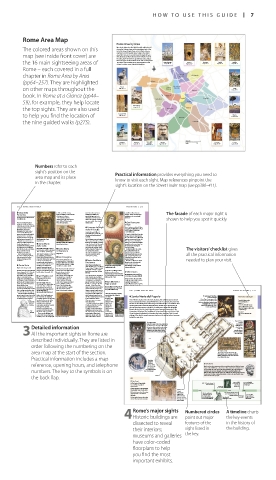
Rome Area Map
Rome Area by Area
The colored areas shown on this Most of the sights described in this book lie within the old
city wall in 16 areas shown on the map below. Each of the
areas has its own chapter. If you are on a short visit, you
map (see inside front cover) are may have to restrict yourself to just a few of the central
areas: the Forum to see ancient Rome; the Capitol, Piazza
della Rotonda and Piazza Navona for the historic centre of
the city; Campo de’ Fiori for its grand Renaissance palazzi;
the 16 main sightseeing areas of Piazza di Spagna for its reminders of the 18th-century Grand Piazza di Spagna Pages 156–67 Pages 252–7 Pages 66–77 Pages 168–77
Tour and its smart modern shops; and the Vatican to see
Via Veneto
Quirinal
Esquiline
Capitol
St Peter’s and the centre of Roman Catholicism.
Pages 130–43
Rome – each covered in a full
chapter in Rome Area by Area Piazza di Via Veneto
Spagna
(pp64–257). They are highlighted Vatican
on other maps throughout the Pages 224–51 Navona Piazza della Quirinal Pages 78–97
Piazza
Vatican
Rotonda
Forum
book. In Rome at a Glance (pp44– Tiber Campo de’
Fiori
Janiculum Capitol Esquiline
59), for example, they help locate Piazza Navona Forum
the top sights. They are also used Pages 118–29 Trastevere Palatine Lateran
to help you find the location of Campo de’ Fiori Aventine Pages 98–103
Palatine
Pages 144–55
the nine guided walks (p275). Caracalla
0 kilometres 1
Piazza della
Janiculum Trastevere Aventine Caracalla Lateran
Rotonda
Pages 216–23 Pages 208–15 Pages 104–17 Pages 200–207 0 miles 0.5 Pages 190–99 Pages 178–89
Numbers refer to each
sight’s position on the Practical information provides everything you need to
area map and its place know to visit each sight. Map references pinpoint the
in the chapter.
sight’s location on the Street Finder map (see pp388–411).
212 ROME AREA B Y AREA TR ASTE VERE 213
1 Casa della in 18th- and 19th-century were taken from previous a woollen mill and various The facade of each major sight is
Fornarina Rome, including reconstructions buildings, including the chapels. Today contemporary
triumphal arch. The mosaic
Via di Santa Dorotea 20. Map 4 D5 & of shops and a tavern. great porphyry ones of a exhibitions are occasionally
The museum also has
held here.
11 B5. @ 23, 280. manuscripts by the much-loved floor is the result of recycling shown to help you spot it quickly.
wrote in local dialect.
Roman ruins.
Not much is known about poets Belli and Trilussa who precious marble from various 0 San Francesco
Raphael’s model and lover, La a Ripa
Fornarina, yet over the centuries
she has acquired a name, 7 Caserma dei Vigili Piazza San Francesco d’Assisi 88. Map
Margherita, and even a della VII Coorte 7 C2. Tel 06-581 9020. @ H, 23, 44, 75,
biography. Her father was a Via della VII Coorte 9. Map 7 C1. 280. v 8. Open 7.30am–1pm,
2–7pm daily. 5 7
Sienese baker (la fornarina Tel 06-0608. @ H, 23, 280, 780. v 8.
means the baker’s girl) and his Closed for restoration work; call St Francis of Assisi lived here in a
shop was here in Trastevere for details. hospice when he visited Rome
near Raphael’s frescoes in the in 1219 and his stone pillow and
Villa Farnesina (see pp220–21). Gilded Baroque altar of Santa Not all Roman ruins are Imperial crucifix are preserved in his cell.
Margherita earned a repu- Maria della Scala villas or grand temples; one that The church was rebuilt by his
tation as a “fallen woman” and Watercolour of public scribe (1880) in the illustrates the daily life of a busy follower, the nobleman Rodolfo
Raphael, wishing to be 3 Santa Maria Museo di Roma in Trastevere city is the barracks of the guards Anguillara, who is portrayed on
absolved before dying, turned della Scala of the VII Coorte (7th Cohort), his tombstone wearing the
her away from his deathbed. Piazza della Scala 23. Map 4 D5 & 11 the Roman fire brigade. It was Franciscan habit. The visitors’ checklist gives
5 Santa Maria
After his death she took refuge B5. Tel 06-580 6233. @ 23, 280. Open in Trastevere built in Augustus’s reign, in the Entirely rebuilt in the 1680s
in the convent of Santa 10am–12.30pm, 4–7pm daily. 5 1st century AD, and the by Cardinal Pallavicini, the
Apollonia in Trastevere. See pp214–15. excavated courtyard is where church is rich in sculptures.
She is assumed to have This church belongs to a time of the men would rest while Particularly flamboyant are the all the practical information
been the model for Raphael’s great building activity that waiting for a call out. 18th-century Rospigliosi and
famous portrait La Donna lasted about 30 years from the 6 San Crisogono Pallavicini monuments in the
Velata in the Palazzo Pitti end of the 16th to the early 17th Piazza Sonnino 44. Map 7 C1. Tel transept chapel. needed to plan your visit.
in Florence. century. Its simple façade 06-5810 0076. @ H, 23, 280, 780. v 8 Santa Cecilia in The Paluzzi-Albertoni chapel
contrasts with a rich interior 8. Open 7.30am–noon, 4.15–7.30pm Trastevere (fourth on the left, along the
2 Ponte Sisto decorated with multicoloured Mon–Sat; 8.30am–1pm, 4.15–7.30pm Piazza di Santa Cecilia. Map 8 D1. Detail of 13th-century fresco by Pietro nave) contains Bernini’s
breathtaking Ecstasy of Beata
marbles and a number of
Sun. & for excavations. 5 7
Tel 06-589 9289. @ H, 23, 44, 280. v
Map 4 E5 & 11 B5. @ 23, 280. spirited Baroque altars and 8. Open 9.30am–12.30pm, 4–6.30pm Cavallini in Santa Cecilia Ludovica Albertoni.
reliefs. In 1849, the church was This church was built on the site
Named after Pope Sixtus IV della used as a hospital to treat Gari- of one of the city’s oldest tituli daily. & for excavations. Cavallini statue of St Cecilia by Stefano
fresco can be seen 10am–12.30pm
Rovere (reigned 1471–84), who baldi’s soldiers (see pp40–41). (private houses used for Mon–Sat. Maderno, who used her q Villa Sciarra
commissioned it, this bridge Christian worship). An miraculously preserved remains Via Calandrelli 35. Map 7 B2. @ 44,
was built by Baccio Pontelli to 4 Sant’Egidio and 8th-century church with 11th- St Cecilia, aristocrat and patron as a model when she was briefly 75. Park: Open 9am–sunset daily. 7
replace an ancient Roman Museo di Roma century frescoes can still be saint of music, was martyred disinterred in 1599.
bridge. The enterprising pope seen beneath the present here in AD 230. After an attempt In Roman times the site of this
also built the Sistine Chapel (see in Trastevere church. This dates from the at scalding her to death, she small, attractive public park was
pp242–5), the Hospital of Santo Piazza Sant’Egidio 1. Map 7 C1. early 12th century, a period of was beheaded. A church was 9 San Michele a a nymph’s sanctuary. It is
Spirito (see p246) and restored @ H, 23, 280. v 8. Church: Tel 06- 58 intense building activity in founded – perhaps in the 4th Ripa Grande especially picturesque in spring
many churches and 56 61. Open 10am–12.30pm Sat. Rome. San Crisogono was century – on the site of her when its wisterias are in full
monuments. This put him in Museo di Roma in Trastevere: Tel decorated by Pietro Cavallini – house. (The house, beneath the Via di San Michele 25. Map 8 D2. Tel bloom. The paths through the
great financial difficulties and he 06-581 6563. Open 10am–8pm Tue– the apse mosaic remains. church with the remains of a 06-584 31. @ 23, 44, 75, 280. Open park are de corated with
140 ROME AREA B Y AREA
had to sell personal collections Sun (last adm: 7pm). 7 Most of the church’s columns Roman tannery, is well worth a for special exhibitions only. Romantic follies, fountains and PIAZZA DI SP A GNA 141
in order to finance his projects. ∑ museodiromaintrastevere.it visit.) Her body turned up in the statues, and there are splendid
Another method of finan cing Catacombs of San Callisto (see This huge, imposing complex, views over the bastions of
projects was to levy a tax on the Built in 1630, Sant’Egidio was p267) and was buried here in now housing the Ministry the Janiculum. . Caravaggio Paintings
city’s prostitutes. Several popes the church of the adjoining the 9th century by Pope Paschal of Culture, u Santa Maria del Popolo in Cerasi Chapel VISITORS’ CHECKLIST
are known to have resorted Carmelite convent, one of many I, who rebuilt the church. stretches 300 One of two Caravaggios in the
to this founded in the area to shelter A fine apse mosaic survives m (985 ft) One of Rome’s greatest stores of artistic treasures, this early Renaissance church Cerasi Chapel, The Crucifixion of St Practical Information
unpopular the poor and destitute. The from this period. along the river was commissioned by Pope Sixtus IV della Rovere in 1472. Among the artists who Peter uses dramatic foreshortening Piazza del Popolo 12.
form of convent is now a museum, The altar canopy by Arnolfo di Tiber. It was worked on the building were Andrea Bregno and Pinturicchio. Later additions were to highlight the sheer effort Map 4 F1.
taxation. containing a wealth of material Cambio and the fresco of The built on the made by Bramante and Bernini. Many illustrious families have chapels here, all involved in turning the saint’s Tel 06-361 0836.q Flaminio.
Open 7.30am noon, 4–7pm
relating to the festivals, Last Judgment by Pietro initiative of decorated with appropriate splendour. The Della Rovere Chapel has delightful crucifix upside down. Mon–Sat; 7.30am–1.30pm, 4.30–
pastimes, superstitions and Cavallini, reached through the Pope Innocent Pinturicchio frescoes, the Cerasi Chapel has two Caravaggio masterpieces, The 7.15pm Sun. 5
Pope customs of the Romans when adjoining convent, date from XII and Conversion of St Paul and The Crucifixion of St Peter, but the finest of all is the Chigi Transport
the 13th century, one of the few
they lived under papal rule.
contained a
Sixtus IV There are old paintings and periods when Rome had a home for the Chapel designed by Raphael for his patron, the banker Agostino Chigi. The most @ 117, 119, 490, 495, 926.
prints of the city and tableaux distinctive artistic style of its elderly, a boys’ Bernini’s Ecstasy of Beata Ludovica Albertoni (1674) in v 2.
striking of the church’s many Renaissance tombs are the two by Andrea Sansovino
showing scenes of everyday life Apse mosaic in San Crisogono own. In front of the altar is a reform school, San Francesco a Ripa behind the main altar.
Stained Glass
. Chigi Chapel French artist
In 1509
Raphael designed this chapel, which has
Detailed information an altarpiece by Sebastiano del Piombo. Guillaume de
Niches on either side of the altar house
Marcillat was
invited to
sculptures by Bernini and Lorenzetto.
provide Rome’s
3All the important sights in Rome are Mosaics in the dome show God as first two stained-
creator of the seven heavenly bodies.
glass windows.
described individually. They are listed in
order following the numbering on the
area map at the start of the section. . Delphic Sibyl
This is one of a series of frescoes by
Pinturicchio, some Classical and others
Biblical, painted in 1508–10 to decorate
Practical information includes a map Kneeling the ceiling of the apse.
Skeleton
reference, opening hours, and telephone figure of death Nero’s Ghost
This floor
mosaic of the
Nero lived on in the imagination of the people long after the fall of the Roman
was added to Empire. In the Middle Ages a legend arose that a walnut tree growing here on
numbers. The key to the symbols is on the 17th century. the spot where his ashes were buried was haunted by the emperor. Ravens
the Chigi Chapel in
roosting in the tree were thought to be demons tormenting him for his
hideous crimes. When the first church was built here in 1099 by Pope Paschal II,
the tree was cut down, supposedly putting an end to the supernatural events
the back flap. KEY Entrance that had terrified local people.
1 Cybo Chapel 1485–9 Della 1513–16 Raphael
2 The Tomb of Giovanni della 1213–27 Church enlarged Rovere Chapel designs and executes
under Gregory IX
Rovere (1483) is by pupils of painted by Chigi Chapel
Pinturicchio
Andrea Bregno. (c.1454–1513) Pinturicchio
3 The altarpiece of The Assumption
is by Annibale Carracci (1540–1609). Della Rovere 1050 1200 1350 1500
Pinturicchio
4 The altar houses the 13th-century Chapel 1099 Paschal II builds 1472–8 Sixtus IV builds church
painting known as the Madonna painted the chapel over tombs of (one of the first Renaissance 1530–34 Chigi
del Popolo. frescoes in the the Domitia family churches in Rome) 1473 Main Chapel altarpiece
5 The Tomb of Ascanio Sforza, who lunettes and the (which included Nero) in Pope Paschal II altar built built by Sebastiano
(reigned 1099–1118)
honour of the Madonna
del Piombo
died in 1505, is by Andrea Sansovino. Nativity above the
altar in 1490.
Rome’s major sights Numbered circles A timeline charts
4Historic buildings are point out major the key events
dissected to reveal features of the in the history of
their interiors; sight listed in the building.
museums and galleries the key.
have color-coded
floorplans to help
you find the most
important exhibits.
US_006-007_EW_Rome_US.indd 7 16/03/17 11:48 am

