


Page 122 - (DK Eyewitness) Top 10 Travel Guide - Brussels Bruges Ghent & Antwerp
P. 122
120 BEY OND BRUSSELS
Exploring Antwerp
Antwerp stretches out from its centre into its sprawling suburbs
to a distance of some 7 km (4.3 miles). Badly damaged in
both World Wars, the city has a broad mixture of architecture,
ranging from the medieval to the ultra-modern. The old
city centre is concentrated around the cathedral, Onze Lieve
Vrouwe Kathedraal, and the Grote Markt (see pp98–9).
The area around the Centraal Station is the centre of the
international diamond trade. The docks of the Zuid (South)
district have been drained, transforming into one of the most
vibrant parts of town, and the old dockland architecture of
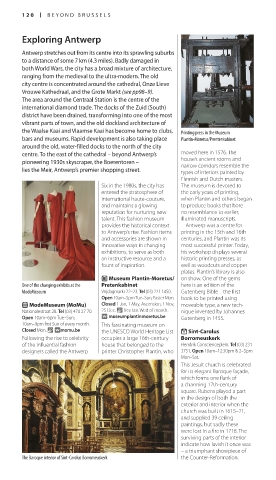
the Waalse Kaai and Vlaamse Kaai has become home to clubs, Printing press in the Museum
bars and museums. Rapid development is also taking place Plantin-Moretus/Prentenkabinet
around the old, water-filled docks to the north of the city
centre. To the east of the cathedral – beyond Antwerp’s moved here in 1576. The
pioneering 1930s skyscraper, the Boerentoren – house’s ancient rooms and
narrow corridors resemble the
lies the Meir, Antwerp’s premier shopping street. types of interiors painted by
Flemish and Dutch masters.
Six in the 1980s, the city has The museum is devoted to
entered the stratosphere of the early years of printing,
international haute-couture, when Plantin and others began
and maintains a glowing to produce books that bore
reputation for nurturing new no resemblance to earlier,
talent. This fashion museum illumi nated manuscripts.
provides the historical context Antwerp was a centre for
to Antwerp’s rise. Fashion items printing in the 15th and 16th
and accessories are shown in centuries, and Plantin was its
innovative ways in changing most successful printer. Today,
exhibitions, to serve as both his workshop displays several
an instructive resource and a historic printing presses, as
fount of inspiration. well as woodcuts and copper
plates. Plantin’s library is also
E Museum Plantin-Moretus/ on show. One of the gems
One of the changing exhibits at the Pretenkabinet here is an edition of the
ModeMuseum Vrijdagmarkt 22–23. Tel (03) 221 1450. Gutenberg Bible – the first
Open 10am–5pm Tue–Sun, Easter Mon. book to be printed using
E ModeMuseum (MoMu) Closed 1 Jan, 1 May, Ascension, 1 Nov, moveable type, a new tech-
Nationalestraat 28. Tel (03) 470 27 70. 25 Dec. & free last Wed of month. nique invented by Johannes
Open 10am–6pm Tue–Sun; ∑ museumplantinmoretus.be Gutenberg in 1455.
10am–9pm first Sun of every month. This fascinating museum on
Closed Mon. & ∑momu.be the UNESCO World Heritage List R Sint-Carolus
Following the rise to celebrity occupies a large 16th-century Borromeuskerk
of the influential fashion house that belonged to the Hendrik Conscienceplein. Tel (03) 231
designers called the Antwerp printer Christopher Plantin, who 3751. Open 10am–12:30pm & 2–5pm
Mon–Sat.
This Jesuit church is celebrated
for its elegant Baroque façade,
which forms one flank of
a charming 17th-century
square. Rubens played a part
in the design of both the
exterior and interior when the
church was built in 1615–21,
and supplied 39 ceiling
paintings, but sadly these
were lost in a fire in 1718. The
surviving parts of the interior
indicate how lavish it once was
– a triumphant showpiece of
The Baroque interior of Sint-Carolus Borromeuskerk the Counter-Reformation.
120-121_EW_Brussels.indd 120 10/01/17 10:54 am
Eyewitness Travel LAYERS PRINTED:
Flashmap follow-on template “UK” LAYER
(Source v1.5)
Date 7th January 2013
Size 125mm x 217mm

