


Page 180 - (DK Eyewitness) Top 10 Travel Guide - Brussels Bruges Ghent & Antwerp
P. 180
178 SUR VIV AL GUIDE
Getting Around Belgium Flanders. It is worth getting
breakdown coverage before
As you might expect from a country that is small, modern and you leave, and you must have a
predominantly flat, Belgium is an extremely easy place in valid driving licence (from the
which to travel. The toll-free motorways compare favourably EU, US, Australia or Canada) or
with any in France, train travel is swift and there are good bus an International Driving Licence
on your person. It is also essential
services in those areas not covered by the railway network. to have comprehensive
Intercity trains leave from all three of the city’s main stations insurance and/or a Green card.
and take 40 minutes to Antwerp (for information on getting Visitors are expected to carry a
around Antwerp, see p116), 40 minutes to Ghent (see p112) first-aid kit, a reflective orange or
and one hour to Bruges (see p100). Public transport is clean yellow jacket and a warning
triangle at all times.
and efficient and the range of touring tickets allows a great All the major car rental
deal of freedom and the ability to see the whole country agencies operate in Belgium,
inexpensively. In the level Flemish countryside to the north, although renting one can be an
hiking and cycling are pleasant ways to get around. expensive business. To hire a
vehicle, you must be 21 or over,
with a year’s driving experience,
and be in possession of a credit
card. A week’s rental with
unlimited mileage will cost €370
or more but might be reduced as
the big firms offer regular special
deals. Local rental agencies may
also be cheaper, but be sure to
check the terms and conditions.
Bicycle hire is available in
most Flemish towns with a
modest deposit of €15.
Travelling by Rail
Run by Belgian National Rail
ways (Société Nationale Chemins
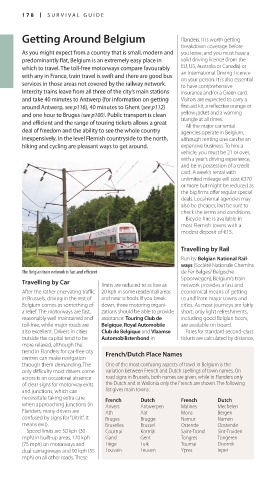
The Belgian train network is fast and efficient de Fer Belges/ Belgische
Spoorwegen), Belgium’s train
Travelling by Car
limits are reduced to as low as network provides a fast and
After the rather enervating traffic 20 kph in some residential areas economical means of getting
in Brussels, driving in the rest of and near schools. If you break to and from major towns and
Belgium comes as something of down, three motoring organi- cities. As most journeys are fairly
a relief. The motorways are fast, zations should be able to provide short, only light refreshments,
reasonably well maintained and assistance: Touring Club de including good Belgian beers,
toll-free, while major roads are Belgique, Royal Automobile are available on board.
also excellent. Drivers in cities Club de Belgique and Vlaamse Fares for standard second-class
outside the capital tend to be Automobilistenbond in tickets are calculated by distance,
more relaxed, although the
trend in Flanders for car-free city French/Dutch Place Names
centres can make navigation
through them demanding. The One of the most confusing aspects of travel in Belgium is the
only difficulty most drivers come variation between French and Dutch spellings of town names. On
across is an occasional absence road signs in Brussels, both names are given, while in Flanders only
of clear signs for motorway exits the Dutch and in Wallonia only the French are shown. The following
and junctions, which can list gives main towns:
necessitate taking extra care French Dutch French Dutch
when approaching junctions (in Anvers Antwerpen Malines Mechelen
Flanders, many drivers are Ath Aat Mons Bergen
confused by signs for “Uitrit”. It Bruges Brugge Namur Namen
means exit). Bruxelles Brussel Ostende Oostende
Speed limits are 50 kph (30 Courtrai Kortrijk Saint-Trond Sint-Truiden
mph) in built-up areas, 120 kph Gand Gent Tongres Tongeren
(75 mph) on motorways and Liège Luik Tournai Doornik
dual carriageways and 90 kph (55 Louvain Leuven Ypres Ieper
mph) on all other roads. These
178-179_EW_Brussels.indd 178 10/01/17 11:05 am

