


Page 48 - (DK Eyewitness) Top 10 Travel Guide - Brussels Bruges Ghent & Antwerp
P. 48
46 BRUSSELS AREA B Y AREA
The Grand Place
The geographical, historical and commercial heart of the city,
the Grand Place is the first port of call for most visitors to
Brussels. The square remains the civic centre, centuries after
its creation, and offers the finest surviving example in one
area of Belgium’s ornate 17th-century architecture. Open-air
markets took place on or near this site as early as the
11th century. By the end of the 15th century Brussels’ town
hall, the Hôtel de Ville, was built, and city traders added
individual guildhouses in a medley of styles. In 1695,
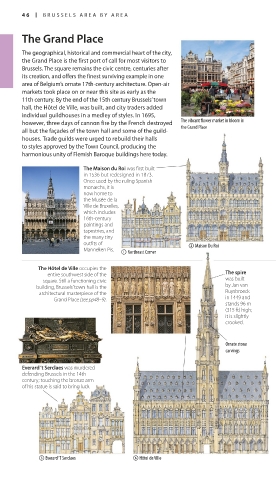
however, three days of cannon fire by the French destroyed The vibrant flower market in bloom in
the Grand Place
all but the façades of the town hall and some of the guild-
houses. Trade guilds were urged to rebuild their halls
to styles approved by the Town Council, producing the
harmon ious unity of Flemish Baroque buildings here today.
The Maison du Roi was first built
in 1536 but redesigned in 1873.
Once used by the ruling Spanish
monarchs, it is
now home to
the Musée de la
Ville de Bruxelles,
which includes
16th-century
paint ings and
tapestries, and
the many tiny
outfits of 2 Maison Du Roi
Manneken Pis.
1 Northeast Corner
The Hôtel de Ville occupies the
entire southwest side of the The spire
square. Still a functioning civic was built
building, Brussels’ town hall is the by Jan van
architectural masterpiece of the Ruysbroeck
Grand Place (see pp48–9). in 1449 and
stands 96 m
(315 ft) high;
it is slightly
crooked.
Ornate stone
carvings
Everard ‘t Serclaes was murdered
defending Brussels in the 14th
century; touching the bronze arm
of his statue is said to bring luck.
5 Everard ‘T Serclaes 6 Hôtel de Ville
046-047_EW_Brussels.indd 46 10/01/17 11:04 am

