


Page 73 - (DK Eyewitness) Top 10 Travel Guide - Brussels Bruges Ghent & Antwerp
P. 73
THE UPPER T OWN 71
Musée Fin de Siècle
The Musée Fin de Siècle
showcases European and
international art from the end
of the 19th century and the
beginning of the 20th century.
This part of the museum has
become a flagship cultural
institution in the world of art
thanks to the exhibits from
the 31 different European
art academies who, in 1868,
created the Société Libre
des Beaux-Arts. The Société
introduced modernism and
the avant-garde to Belgium. The Orange Market at Blidah (1898) by Henri Evenepoel
The rediscovery of the
Primitives, Impressionism, Girl Mending (1890). Belgian Magritte entered the Brussels
Symbolism and Art Nouveau are van de Velde (1863–1957) Academie des Beaux-Arts in
all represented by such artists went on to become one of the 1916. A former poster and
as Khnopff, Seurat, Spilliaert, main founders of Art Nouveau advertisement designer, he
Gauguin, van de Velde, Mucha, in Belgium. created visually strik ing work,
Horta, Ensor and de Vlaminick. A highlight of the museum is frequently displaying a juxta-
There is an excellent collection the extraordinarily rich Gillion position of familiar objects in
of Symbolist art, such as the Crowet Collection of Art unusual, sometimes unsettling,
poetic and disturbing classics Nouveau, which includes combin ations and contexts.
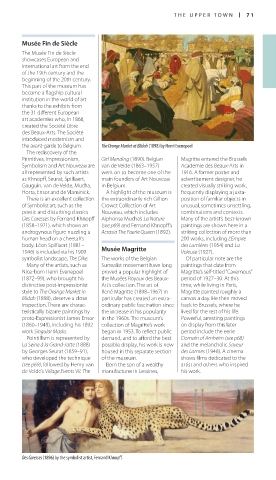
Des Caresses by Fernand Khnopff Alphonse Mucha’s La Nature Many of the artist’s best-known
(1858–1921), which shows an (see p69) and Fernand Khnopff’s paint ings are shown here in a
androgy nous fig ure nuzzling a Acrasia The Faerie Queen (1892). striking col lection of more than
human head on a cheetah’s 200 works, including L’Empire
body. Léon Spilliaert (1881– Musée Magritte des Lumières (1954) and La
1946) is included via his 1909 Voleuse (1927).
symbolist landscape, The Dike. The works of the Belgian Of particular note are the
Many of the artists, such as Surrealist movement have long paintings that date from
Nice-born Henri Evenepoel proved a popular highlight of Magritte’s self-titled “Cavernous”
(1872–99), who brought his the Musées Royaux des Beaux- period of 1927–30. At this
distinctive post-Impressionist Art’s collection. The art of time, while living in Paris,
style to The Orange Market in René Magritte (1898–1967) in Magritte painted roughly a
Blidah (1898), deserve a close particular has created an extra- canvas a day. He then moved
inspection. There are charac- ordinary public fascination since back to Brussels, where he
teristically bizarre paintings by the increase in his popularity lived for the rest of his life.
proto-Expressionist James Ensor in the 1960s. The museum’s Powerful, arresting paintings
(1860–1949), including his 1892 collection of Magritte’s work on display from this later
work Singular Masks. began in 1953. To reflect public period include the eerie
Pointillism is represented by demand, and to afford the best Domain of Arnheim (see p68)
La Seine à la Grand-Jatte (1888) possible display, his work is now and the melan cholic Saveur
by Georges Seurat (1859–91), housed in this separate section des Larmes (1948). A cinema
who developed the technique of the museum. shows films dedicated to the
(see p69), followed by Henry van Born the son of a wealthy artist and others who inspired
de Velde’s Village Events VII. The manufacturer in Lessines, his work.
Des Caresses (1896) by the symbolist artist, Fernand Khnopff.
070-071_EW_Brussels.indd 71 10/01/17 10:54 am

