


Page 163 - (DK Eyewitness) Travel Guide - London
P. 163
THE CIT Y 161
mounted on the walls and
The White Tower
panels in elaborate symmetrical
This is the oldest surviving patterns based on displays in
building in the Tower of London, the Tower armouries in the
begun by William I in 1075 and 18th and 19th centuries. They
completed before 1079. For were shown in the Grand Store
centuries it served as an armoury, house until it burned down in
and much of the national collec 1841. A collection of weapons
tion of arms and armour is held taken from the men who
here. “Fit for a King” showcases planned to assassinate William
500 years of royal arms and III in 1696 is on show, and a
armour, while “Hands on History” wooden block made in 1747 for
(which is set to be revamped the execution of Lord Lovat –
in the near future) allows the last public beheading in
visitors to get to grips with England – is on the third floor.
items of weaponry. The crypt now houses a shop.
The “Power House” exhibition
tells the stories of what went on The Line of Kings
behind the Tower’s walls from The Line of Kings, ten lifesize
1100 to the present day, and carvings of prominent English
brings to life the personalities Monarchs, wearing armour and
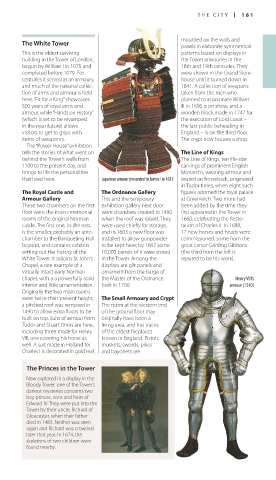
that lived here. Japanese armour presented to James I in 1613 seated on horseback, originated
in Tudor times, when eight such
The Royal Castle and The Ordnance Gallery figures adorned the royal palace
Armour Gallery This and the temporary at Greenwich. Two more had
These two chambers on the first ex hibition gallery next door been added by the time they
floor were the main ceremonial were chambers created in 1490 first appeared in the Tower in
rooms of the original Norman when the roof was raised. They 1660, celebrating the Resto
castle. The first one, to the east, were used chiefly for storage, ration of Charles II. In 1688,
is the smaller, probably an ante and in 1603 a new floor was 17 new horses and heads were
chamber to the Banqueting Hall installed to allow gun powder commissioned, some from the
beyond, and contains exhibits to be kept here; by 1667 some great carver Grinling Gibbons
setting out the history of the 10,000 barrels of it were stored (the third from the left is
White Tower. It adjoins St John’s in the Tower. Among the reputed to be his work).
Chapel, a rare example of a displays are gilt panels and
virtually intact early Norman ornament from the barge of
chapel, with a a powerfully solid the Master of the Ordnance Henry VIII’s
interior and little ornament ation. built in 1700. armour (1540)
Originally the two main rooms
were twice their present height; The Small Armoury and Crypt
a pitched roof was removed in The room at the western end
1490 to allow extra floors to be of the ground floor may
built on top. Suits of armour from originally have been a
Tudor and Stuart times are here, living area, and has traces
including three made for Henry of the oldest fireplaces
VIII, one covering his horse as known in England. Pistols,
well. A suit made in Holland for muskets, swords, pikes
Charles I is decorated in gold leaf. and bayonets are
The Princes in the Tower
Now explored in a display in the
Bloody Tower, one of the Tower’s
darkest mysteries concerns two
boy princes, sons and heirs of
Edward IV. They were put into the
Tower by their uncle, Richard of
Gloucester, when their father
died in 1483. Neither was seen
again and Richard was crowned
later that year. In 1674, the
skeletons of two children were
found nearby.
160-161_EW_London.indd 161 21/03/17 2:20 pm

