


Page 168 - (DK Eyewitness) Travel Guide - London
P. 168
166 L ONDON AREA B Y AREA
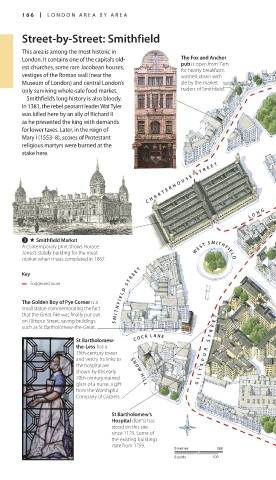
Street-by-Street: Smithfield
This area is among the most historic in
London. It contains one of the capital’s old The Fox and Anchor
pub is open from 7am
est churches, some rare Jacobean houses, for hearty breakfasts,
vestiges of the Roman wall (near the washed down with
Museum of London) and central London’s ale by the market
only surviving wholesale food market. traders of Smithfield.
Smithfield’s long history is also bloody.
In 1381, the rebel peasant leader Wat Tyler
was killed here by an ally of Richard II C H A R T E R H O U S E S Q U A R E
as he presented the king with demands
for lower taxes. Later, in the reign of
Mary I (1553–8), scores of Protestant
religious martyrs were burned at the
stake here.
C H A R T E R H O U S E S T R E E T L A N E
L O N G
C L O T H F A I R
3 . Smithfield Market
A contemporary print shows Horace
Jones’s stately building for the meat
market when it was completed in 1867. W E S T S M I T H F I E L D
Key
Suggested route
The Golden Boy of Pye Corner is a S M I T H F I E L D S T R E E T
small statue commemorating the fact
that the Great Fire was finally put out T
on Giltspur Street, saving buildings E
such as St Bartholomew-the-Great. E
R
St Bartholomew- C O C K L A N E S T
the-Less has a R
15th-century tower U
and vestry. Its links to P
the hospital are S
shown by this early S N O W H I L L L T
20th- century stained I
glass of a nurse, a gift G
from the Worshipful
Company of Glaziers.
St Bartholomew’s
Hospital (Bart’s) has
stood on this site
since 1123. Some of
the existing buildings
date from 1759.
0 metres 100
0 yards 100
166-167_EW_London.indd 166 21/03/17 2:25 pm

