


Page 21 - (DK Eyewitness) Travel Guide - London
P. 21
INTRODUCING L ONDON 19
THE HISTORY
OF LONDON
In 55 BC, Julius Caesar’s Roman army had enveloped the settlements around it.
invaded England, landing in Kent and These included the royal City of Westminster,
marching northwest until it reached which had long been London’s religious
the broad River Thames at what is now and political centre. The explosive growth
Southwark. There were a few tribesmen of commerce and industry during the
living on the opposite bank but no major 18th and 19th centuries made London
settlement. However, by the time of the the biggest and wealthiest city in the world,
second Roman invasion 88 years later, a creating a prosperous middle class who built
small port and mercantile community had the fine houses that still grace parts of the
been established here. The Romans bridged capital. The prospect of riches also lured
the river and built their administrative millions of the dispossessed from the country-
headquarters on the north bank, calling it side and from abroad. They crowded into
Londinium – a version of its old Celtic name. insanitary dwellings, many just east of the
City, where docks provided employment.
London as Capital By the end of the 19th century, 4.5 million
London was soon the largest city in people lived in inner London and another
England and, by the time of the Norman 4 million in its immediate vicinity. Bombing
Conquest in 1066, it was the obvious during World War II devastated many of
choice for national capital. the central areas and led to substantial
Settlement slowly spread beyond the rebuilding in the second half of the
original walled city, which was virtually 20th century, when the docks and other
wiped out by the Great Fire of 1666. The Victorian industries disappeared.
post-fire rebuilding formed the basis The following pages illustrate London’s
of the area we know today as the City of history by giving snapshots of significant
London but, by the 18th century, London periods in its evolution.
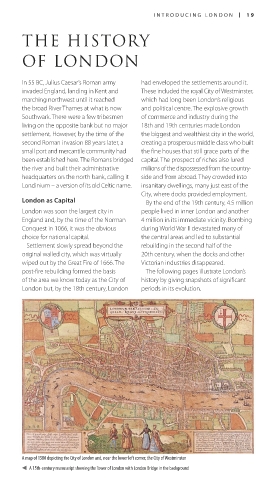
A map of 1580 depicting the City of London and, near the lower left corner, the City of Westminster
A 15th-century manuscript showing the Tower of London with London Bridge in the background
018-019_EW_London.indd 19 21/03/17 2:19 pm

