


Page 238 - (DK Eyewitness) Travel Guide - London
P. 238
236 L ONDON AREA B Y AREA
writer Rudyard Kipling, who
visited here occasionally in the
last years of his life until 1936.
After a period under the
ownership of Hampstead
Borough Council, the house
was let to the independent
Burgh House Trust. Since 1979,
the Trust has run it as the
Hampstead Museum, which
illustrates the history of the
area and concentrates on some
of its most celebrated residents.
The museum owns a signif
Site of the well on Well Walk that provided icant art collection, including
Hampstead with its spa waters works by the Bloomsbury Group
painter Duncan Grant, along Burgh House staircase
1 Flask Walk and with furniture and archive
Well Walk material on the area. There is 3 Fenton House
a display about Hampstead as
NW3. Map 1 B5. 1 Hampstead. a spa in the 18th and 19th 20 Hampstead Grove NW3. Map 1 A4.
centuries and exhibitions by Tel 020 7435 3471. 1 Hamp stead.
Open Mar–Oct: 11am–5pm Wed–Sun
Flask Walk is named after the Flask contemporary local artists are & public hols. & 7 ground floor
pub. Here, in the 18th century, often displayed in the ground only. = ∑ nationaltrust.org.uk/
the area’s therapeutic spa water floor gallery. fentonhouse
was put into flasks and sold to The house itself was built in
visitors or sent to London. The 1703 but is named after a Built in 1686, this splendid
water, rich in iron salts, came 19thcentury resident, the William and Mary house is
from nearby Well Walk, where a Reverend Allatson Burgh. It the oldest mansion in
disused fountain now marks the has been much altered inside, Hampstead. It contains several
site of the well. The Wells Tavern, and today the marvellously specialist exhibi tions that are
almost opposite the spring, was carved staircase is a highlight open to the public during
a hostelry that accommodated of the interior. Also worth the summer: the Benton
those who engaged in the illicit seeing is the music room, Fletcher collection of early
liaisons for which the spa which was reconstructed in keyboard instruments, which
became notorious. 1920 but contains 18thcentury includes a harpsichord dating
There have been many notable panelling from another house. from 1612, said to have been
residents of Well Walk, including In the 1720s, Dr William played by Handel; and a fine
artist John Constable (at No. 40), Gibbons, chief physician to collection of porcelain. The
novelists D H Lawrence and J B the then thriving Hampstead instruments are kept in full
Priestley, and the poet John spa, lived here. working order and are used
Keats, before he moved to what
is now Keats Grove (see facing
page). At the High Street end,
Flask Walk is narrow and lined
with old shops. Beyond the
Flask pub (note the Victorian
tiled panels outside) it broadens
into a row of Regency houses,
one of which used to belong to
the novelist Kingsley Amis.
2 Burgh House
New End Sq NW3. Map 1 B4. Tel 020
7431 0144. 1 Hampstead. Open
noon–5pm Wed–Fri & Sun. Café:
11am–5pm Wed–Fri, 9.30am–5:30pm
Sat & Sun Closed Christmas week.
- = Music recitals.
∑ burghhouse.org.uk
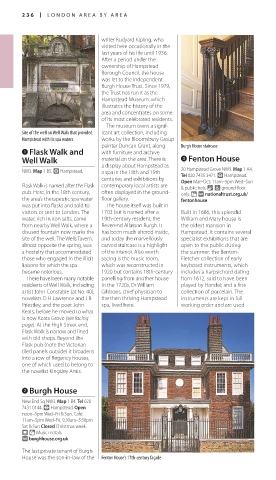
The last private tenant of Burgh
House was the soninlaw of the Fenton House’s 17th-century façade
236-237_EW_London.indd 236 21/03/17 2:21 pm

