


Page 52 - (DK Eyewitness) Travel Guide - London
P. 52
50 INTRODUCING L ONDON
Exploring Churches
The church spires that puncture London’s sky
line span nearly a thousand years of the city’s
history. They form an index to many of the events
and periods that have shaped the city – the Norman
Conquest (1066); the Great Fire of London (1666);
the great restoration that followed it; the Regency
period; the confidence of the Victorian era; and
the devastation of World War II. Each has had its
effect on the churches, many designed by the
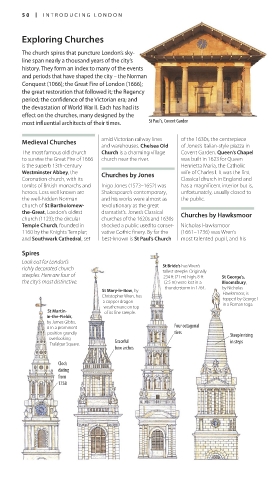
most influential architects of their times. St Paul’s, Covent Garden
Medieval Churches amid Victorian railway lines of the 1630s, the centrepiece
and warehouses. Chelsea Old of Jones’s Italian-style piazza in
The most famous old church Church is a charming village Covent Garden. Queen’s Chapel
to survive the Great Fire of 1666 church near the river. was built in 1623 for Queen
is the superb 13th-century Henrietta Maria, the Catholic
Westminster Abbey, the Churches by Jones wife of Charles I. It was the first
Coronation church, with its Classical church in England and
tombs of British monarchs and Inigo Jones (1573–1652) was has a magnificent interior but is,
heroes. Less well known are Shakespeare’s contemporary, unfortunately, usually closed to
the well-hidden Norman and his works were almost as the public.
church of St Bartholomew- revolutionary as the great
the-Great, London’s oldest dramatist’s. Jones’s Classical Churches by Hawksmoor
church (1123); the circular churches of the 1620s and 1630s
Temple Church, founded in shocked a public used to conser- Nicholas Hawksmoor
1160 by the Knights Templar; vative Gothic finery. By far the (1661–1736) was Wren’s
and Southwark Cathedral, set best-known is St Paul’s Church most talented pupil, and his
Spires
Look out for London’s
richly decorated church St Bride’s has Wren’s
tallest steeple. Originally
steeples. Here are four of 234 ft (71 m) high, 8 ft St George’s,
the city’s most distinctive. (2.5 m) were lost in a Bloomsbury,
thunderstorm in 1764. by Nicholas
St Mary-le-Bow, by
Christopher Wren, has Hawksmoor, is
a copper dragon topped by George I
weathervane on top in a Roman toga.
St Martin- of its fine steeple.
in-the-Fields,
by James Gibbs,
is in a prominent Four octagonal
position grandly tiers Steeple rising
overlooking Graceful
Trafalgar Square. in steps
bow arches
Clock
dating
from
1758
050-051_EW_London.indd 50 21/03/17 2:20 pm

