


Page 53 - (DK Eyewitness) Travel Guide - London
P. 53
L ONDON A T A GLANCE 51
churches are among the finest Christopher Wren
Baroque buildings to be found
in Britain. Sir Christopher Wren St Paul’s, while
St George’s, Bloomsbury (1632–1723) played an nearby is splendid
(1716–31) has an unusual integral part in the St Stephen
centralized plan and a pyramid restoration of London Walbrook, his
steeple topped by a statue after the Great Fire domed church of
of King George I. St Mary of 1666. He devised 1672–7. Other
Woolnoth is a tiny jewel of a new city plan, landmarks are
St Bride’s, off Fleet
1716–27, and further east, replacing the narrow Street, said to have
streets with wide
Christ Church, Spitalfields inspired the traditional
isa Baroque tour-de-force avenues radiating shape of wedding cakes,
from piazzas. His plan
of 1714–29. was rejected, but he was St Mary-le-Bow in Cheapside
Among Hawksmoor’s East commissioned to build 52 and St Magnus the Martyr
End churches are the stunning new churches; 31 have in Lower Thames Street. Wren’s
St Anne’s, Limehouse and survived various threats of own favourite was St James’s,
St Alfege, of 1714–17, which is demolition and the bombs Piccadilly (1683–4). Smaller
across the river in Greenwich. of World War II, although six gems are St Clement Danes,
The tower on this temple-like are shells. Wren’s great Strand (1680–82), and St James,
church was added later by masterpiece is the massive Garlickhythe (1674–87).
John James in 1730.
churches in London’s new Cathedral,a stunningly rich,
suburbs fused with a Greek Italianate Catholic cathedral
Revival. The results may lack built in 1895–1903, with
the exuberance of Hawksmoor, architecture by J F Bentley
but they have an austere and Stations of the Cross reliefs
elegance of their own. All Souls, by Eric Gill. Brompton Oratory
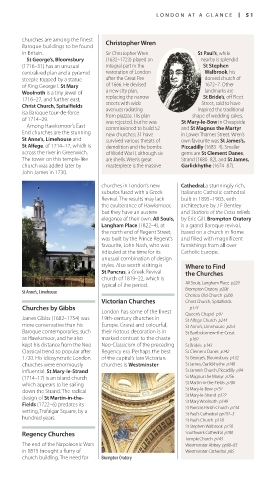
Langham Place (1822–4), at is a grand Baroque revival,
the north end of Regent Street, based on a church in Rome
was built by the Prince Regent’s and filled with magnificent
favourite, John Nash, who was furnishings from all over
ridiculed at the time for its Catholic Europe.
unusual combination of design
styles. Also worth visiting is Where to Find
St Pancras, a Greek Revival the Churches
church of 1819–22, which is
typical of the period. All Souls, Langham Place p229
St Anne’s, Limehouse Brompton Oratory p208
Chelsea Old Church p200
Victorian Churches Christ Church, Spitalfields
Churches by Gibbs p174
London has some of the finest Queen’s Chapel p97
James Gibbs (1682–1754) was 19th-century churches in St Alfege Church p244
more conservative than his Europe. Grand and colourful, St Anne’s, Limehouse p253
Baroque contemporaries, such their riotous decoration is in St Bartholomew-the-Great
as Hawksmoor, and he also marked contrast to the chaste p169
kept his distance from the Neo- Neo-Classicism of the preceding St Bride’s p143
Classical trend so popular after Regency era. Perhaps the best St Clement Danes p142
1720. His idiosyncratic London of the capital’s late Victorian St George’s, Bloomsbury p132
churches were enormously churches is Westminster St James, Garlickhythe p148
influential. St Mary-le-Strand St James’s Church, Piccadilly p94
(1714–17) is an island church St Magnus the Martyr p156
which appears to be sailing St Martin-in-the-Fields p106
down the Strand. The radical St Mary-le-Bow p151
St Mary-le-Strand p122
design of St Martin-in-the- St Mary Woolnoth p149
Fields (1722–6) predates its St Pancras Parish Church p134
setting, Trafalgar Square, by a St Paul’s Cathedral pp152–5
hundred years. St Paul’s Church p118
St Stephen Walbrook p150
Regency Churches Southwark Cathedral p180
Temple Church p143
The end of the Napoleonic Wars Westminster Abbey pp80–83
in 1815 brought a flurry of Westminster Cathedral p85
church building. The need for Brompton Oratory
050-051_EW_London.indd 51 21/03/17 2:20 pm

