


Page 182 - Inventions - A Visual Encyclopedia (DK - Smithsonian)
P. 182
The light bulb


          Scientists spent much of the 19th century trying to
          turn electricity into light. Their goal was to create

          a long-lasting electric light for home use. Two
          inventors—Joseph Swan and Thomas Edison—

          working independently on either side of the Atlantic
          Ocean, came up with the solution: the incandescent
      AT HOME  light bulb. This invention transformed the world.                    Before the invention of the electric light,
                                                                                           LIFE IN THE DARK


                                                                                    People lit up their homes using candles
                   LIGHTING THE WAY                                                 the world was a much darker place.
                Invented by the British scientist                                   made of animal fat and beeswax, as well
            Humphry Davy in 1809, the arc lamp                                      as oil lamps and gas lamps. All were
                                                                                    much less effective than electricity—
              worked by passing a bright arc of                                     a 100-watt light bulb is more than 100
             electricity through the air between                                    times brighter than a candle flame.
            two charcoal rods—like a controlled
            lightning strike. Although it was the
           first practical light, it was too powerful
            for home use. Arc lamps were used
                      mainly for street lighting.
                                                Arc lamps illuminate a street
                                                    in New York in 1881
                                                                                         WOW!


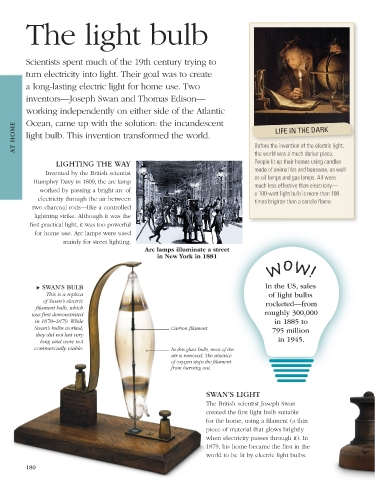
             ▶ SWAN’S BULB                                                              In the US, sales
                This is a replica                                                        of light bulbs
               of Swan’s electric                                                       rocketed—from
             filament bulb, which
           was first demonstrated                                                      roughly 300,000
            in 1878–1879. While                                                            in 1885 to
            Swan’s bulbs worked,                         Carbon filament                  795 million
             they did not last very
              long and were not                                                             in 1945.
            commercially viable.                         In this glass bulb, most of the
                                                         air is removed. The absence
                                                         of oxygen stops the filament
                                                         from burning out.


                                                                    SWAN’S LIGHT
                                                                    The British scientist Joseph Swan
                                                                    created the first light bulb suitable
                                                                    for the home, using a filament (a thin
                                                                    piece of material that glows brightly
                                                                    when electricity passes through it). In
                                                                    1879, his home became the first in the
                                                                    world to be lit by electric light bulbs.
          180


   US_180-181_Light_Bulb_Main.indd   180                                                                         08/03/18   3:10 PM

