


Page 198 - Inventions - A Visual Encyclopedia (DK - Smithsonian)
P. 198
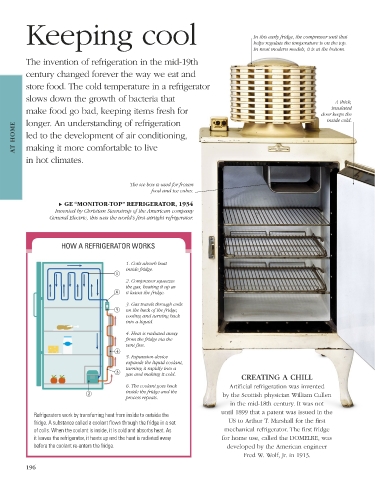
Keeping cool                                                              In this early fridge, the compressor unit that


                                                                                    helps regulate the temperature is on the top.
                                                                                    In most modern models, it is at the bottom.

          The invention of refrigeration in the mid-19th
          century changed forever the way we eat and

          store food. The cold temperature in a refrigerator
          slows down the growth of bacteria that                                                              A thick,
                                                                                                             insulated
          make food go bad, keeping items fresh for                                                       door keeps the
                                                                                                            inside cold.
          longer. An understanding of refrigeration
      AT HOME  led to the development of air conditioning,

          making it more comfortable to live

          in hot climates.


                                           The ice box is used for frozen
                                                  food and ice cubes.

                    ▶ GE “MONITOR-TOP” REFRIGERATOR, 1934
                   Invented by Christian Steenstrup of the American company
                 General Electric, this was the world’s first airtight refrigerator.


                     HOW A REFRIGERATOR WORKS


                                          1. Coils absorb heat
                                          inside fridge.
                                       1
                                          2. Compressor squeezes
                                          the gas, heating it up as
                                       6  it leaves the fridge.
                                          3. Gas travels through coils
                                       5  on the back of the fridge,
                                          cooling and turning back
                                          into a liquid.
                                          4. Heat is radiated away
                                          from the fridge via the
                                          vent fins.
                                       4
                                          5. Expansion device
                                          expands the liquid coolant,
                                          turning it rapidly into a
                                       3  gas and making it cold.
                                                                                CREATING A CHILL
                                          6. The coolant goes back          Artificial refrigeration was invented
                                          inside the fridge and the
                              2                                           by the Scottish physician William Cullen
                                          process repeats.
                                                                            in the mid-18th century. It was not
            Refrigerators work by transferring heat from inside to outside the   until 1899 that a patent was issued in the
            fridge. A substance called a coolant flows through the fridge in a set    US to Arthur T. Marshall for the first
            of coils. When the coolant is inside, it is cold and absorbs heat. As    mechanical refrigerator. The first fridge
            it leaves the refrigerator, it heats up and the heat is radiated away    for home use, called the DOMELRE, was
            before the coolant re-enters the fridge.                       developed by the American engineer
                                                                                 Fred W. Wolf, Jr. in 1913.
          196


   US_196-197_Keeping_Cool_Main.indd   196                                                                       12/04/18   1:30 PM

