


Page 206 - Inventions - A Visual Encyclopedia (DK - Smithsonian)
P. 206
Recorded                                                                                    Cylinder


          music                                                            Hand crank turns
                                                                           the cylinder.


          Until the late 19th century, the only way to hear

          music was to listen to it live. Then the invention
          of the telephone in 1876 showed that sound
      AT HOME  could be transmitted electrically. This spurred       attached here to             PHONOGRAPH
                                                                          Horn was
          the American inventor Thomas Edison (see
                                                                     magnify sound.
          pp.186–187) to explore if it was possible to                             Invented in 1877, Edison’s phonograph
                                                                              consisted of a horn, a needle, and a rotating
          record sound. His invention, the phonograph,                            cylinder covered in tin foil. When sound

          kick-started the recorded music industry.                            was played into the horn, the needle traced
                                                                                a groove in the foil as the cylinder turned.
                                                                                   To play back the recording, the needle
                                                                                    was drawn through the groove again.
                                                                                  Later phonographs used a wax cylinder
         RECORDING WITHOUT ELECTRICITY
                                                                                 to make and play recordings (see p.206).
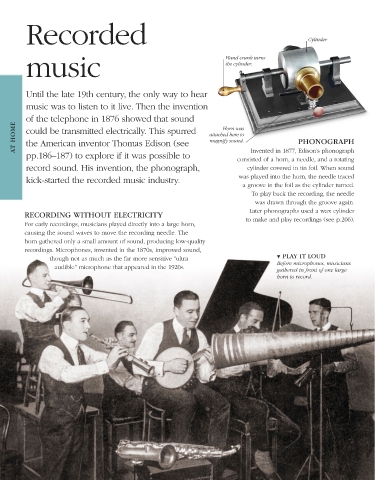
         For early recordings, musicians played directly into a large horn,
         causing the sound waves to move the recording needle. The
         horn gathered only a small amount of sound, producing low-quality
         recordings. Microphones, invented in the 1870s, improved sound,
                 though not as much as the far more sensitive “ultra                       ▼ PLAY IT LOUD
                                                                                           Before microphones, musicians
                   audible” microphone that appeared in the 1920s.
                                                                                           gathered in front of one large
                                                                                           horn to record.


   US_204-205_Recorded_music_Main.indd   204                                                                     16/03/18   3:41 PM

