


Page 208 - Inventions - A Visual Encyclopedia (DK - Smithsonian)
P. 208
Listen to


                                              the music


                                              The devices we use for listening to music have

                                                 changed dramatically over the years. For much of
                                                  the 20th century, most of the developments were
      AT HOME                                     the move has been toward making equipment
                                                   aimed at improving sound quality. In recent times,


                                                 smaller and lighter. A record collection—along with
                                               the device to play the records—has evolved from

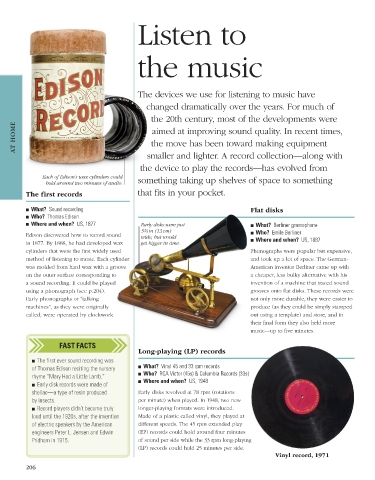
               Each of Edison’s wax cylinders could   something taking up shelves of space to something
                hold around two minutes of audio.
          The first records                   that fits in your pocket.

          ■ ■ What?  Sound recording                                               Flat disks
          ■ ■ Who?  Thomas Edison
          ■ ■ Where and when?  US, 1877        Early disks were just               ■ ■ What?  Berliner gramophone
                                               53/4 in (13 cm)                      ■ Who?  Emile Berliner
          Edison discovered how to record sound    wide, but would                 ■
          in 1877. By 1888, he had developed wax   get bigger in time.             ■ ■ Where and when?  US, 1887
          cylinders that were the first widely used                                Phonographs were popular but expensive,
          method of listening to music. Each cylinder                              and took up a lot of space. The German-
          was molded from hard wax with a groove                                   American inventor Berliner came up with
          on the outer surface corresponding to                                    a cheaper, less bulky alternative with his
          a sound recording. It could be played                                    invention of a machine that traced sound
          using a phonograph (see p.204).                                          grooves onto flat disks. These records were
          Early phonographs or “talking                                            not only more durable, they were easier to
          machines”, as they were originally                                       produce (as they could be simply stamped
          called, were operated by clockwork.                                      out using a template) and store, and in
                                                                                   their final form they also held more
                                                                                   music—up to five minutes.

                    FAST FACTS
                                              Long-playing (LP) records
           ■ ■ The first ever sound recording was
           of Thomas Edison reciting the nursery   ■ ■ What?  Vinyl 45 and 33 rpm records
           rhyme “Mary Had a Little Lamb.”    ■ ■ Who?  RCA Victor (45s) & Columbia Records (33s)
                                               ■ Where and when?  US, 1948
           ■ ■ Early disk records were made of   ■
           shellac—a type of resin produced    Early disks revolved at 78 rpm (rotations
           by insects.                        per minute) when played. In 1948, two new
           ■ ■ Record players didn’t become truly   longer-playing formats were introduced.
           loud until the 1920s, after the invention   Made of a plastic called vinyl, they played at
           of electric speakers by the American   different speeds. The 45 rpm extended play
           engineers Peter L. Jensen and Edwin   (EP) records could hold around four minutes
           Pridham in 1915.                   of sound per side while the 33 rpm long-playing
                                              (LP) records could hold 25 minutes per side.
                                                                                           Vinyl record, 1971
          206


   US_206-207_Listen_to_the_music_Gallery.indd   206                                                             09/03/18   4:06 PM

