


Page 43 - Inventions - A Visual Encyclopedia (DK - Smithsonian)
P. 43
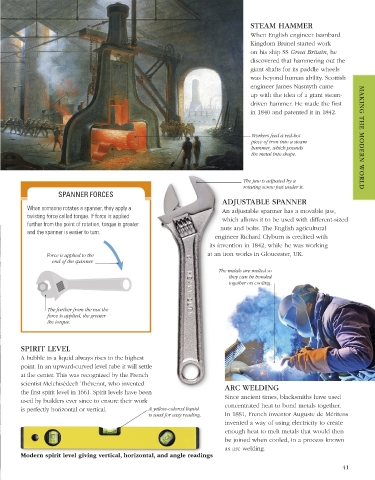
STEAM HAMMER
                                                                                   When English engineer Isambard
                                                                                   Kingdom Brunel started work
                                                                                   on his ship SS Great Britain, he
                                                                                   discovered that hammering out the
                                                                                   giant shafts for its paddle wheels
                                                                                   was beyond human ability. Scottish
                                                                                   engineer James Nasmyth came
                                                                                   up with the idea of a giant steam-
                                                                                   driven hammer. He made the first
                                                                                   in 1840 and patented it in 1842.


                                                                                   Workers feed a red-hot              MAKING THE MODERN WORLD
                                                                                   piece of iron into a steam
                                                                                   hammer, which pounds
                                                                                   the metal into shape.


                                                                                The jaw is adjusted by a
                                                                                rotating screw just under it.
                    SPANNER FORCES
                                                                          ADJUSTABLE SPANNER
          When someone rotates a spanner, they apply a                    An adjustable spanner has a movable jaw,
          twisting force called torque. If force is applied               which allows it to be used with different-sized
          further from the point of rotation, torque is greater          nuts and bolts. The English agricultural
          and the spanner is easier to turn.
                                                                       engineer Richard Clyburn is credited with
                                                                     its invention in 1842, while he was working
                Force is applied to the                              at an iron works in Gloucester, UK.
                  end of the spanner.
                                                                        The metals are melted so
                                                                            they can be bonded
                                                                            together on cooling.


                The further from the nut the
                force is applied, the greater
                the torque.


        SPIRIT LEVEL
        A bubble in a liquid always rises to the highest
        point. In an upward-curved level tube it will settle
        at the center. This was recognized by the French
        scientist Melchisédech Thévenot, who invented                     ARC WELDING
        the first spirit level in 1661. Spirit levels have been
                                                                          Since ancient times, blacksmiths have used
        used by builders ever since to ensure their work                  concentrated heat to bond metals together.
        is perfectly horizontal or vertical.      A yellow-colored liquid
                                                  is used for easy reading.  In 1881, French inventor Auguste de Méritens
                                                                          invented a way of using electricity to create
                                                                          enough heat to melt metals that would then
                                                                          be joined when cooled, in a process known
                                                                          as arc welding.
        Modern spirit level giving vertical, horizontal, and angle readings
                                                                                                                 41


   US_040-041_308121_Tools.indd   41                                                                             08/03/2018   17:16

