


Page 47 - Inventions - A Visual Encyclopedia (DK - Smithsonian)
P. 47
PEST CONTROL
                                                                                   In 1939, Swiss chemist Paul Müller
                                                                                   discovered that a chlorine-based
                                                                                   chemical, commonly called DDT,
                                                                                   killed insects but had little effect on
                                                                                   warm-blooded animals. DDT was
                                                                                   used widely in agriculture for years,
                                                                                   but today it has been replaced by
                                                                                   more effective and safer pesticides.


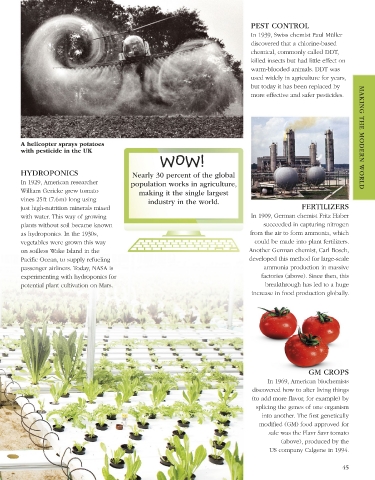
        A helicopter sprays potatoes                                                                                   MAKING THE MODERN WORLD
        with pesticide in the UK
                                                     WOW!

        HYDROPONICS                         Nearly 30 percent of the global
        In 1929, American researcher        population works in agriculture,
        William Gericke grew tomato           making it the single largest
        vines 25 ft (7.6 m) long using           industry in the world.
        just high-nutrition minerals mixed                                                          FERTILIZERS
        with water. This way of growing                                            In 1909, German chemist Fritz Haber
        plants without soil became known                                               succeeded in capturing nitrogen
        as hydroponics. In the 1930s,                                              from the air to form ammonia, which
        vegetables were grown this way                                              could be made into plant fertilizers.
        on soilless Wake Island in the                                            Another German chemist, Carl Bosch,
        Pacific Ocean, to supply refueling                                        developed this method for large-scale
        passenger airliners. Today, NASA is                                            ammonia production in massive
        experimenting with hydroponics for                                            factories (above). Since then, this
        potential plant cultivation on Mars.                                            breakthrough has led to a huge
                                                                                   increase in food production globally.


                                                                                                      GM CROPS
                                                                                        In 1969, American biochemists
                                                                                   discovered how to alter living things
                                                                                   (to add more flavor, for example) by
                                                                                     splicing the genes of one organism
                                                                                       into another. The first genetically
                                                                                      modified (GM) food approved for
                                                                                         sale was the Flavr Savr tomato
                                                                                             (above), produced by the
                                                                                         US company Calgene in 1994.

                                                                                                                 45


   US_044-045_308121_Feeding_the_world.indd   45                                                                 08/03/2018   17:17

