


Page 117 - (DK Eyewitness) Travel Guide - Sweden
P. 117
M ALM ARNA & FUR THER AFIELD 115
Chinese Pavilion (Kina Slott) the Flemish sculptor
which is still one of the major Adrian de Vries (1560–
attractions at Drottningholm. 1626) were war
The polishedtile building was trophies from Prague
designed by D F Adelcrantz in 1648 and from
(1716–96). Fredriksborg Castle
At this time there was great in Denmark in 1659.
European interest in all things The avenues of chest
Chinese. In 1733 the newly nut trees were laid out
formed East India Company when the Chinese
made its first journey to China. Pavilion was completed,
After Lovisa Ulrika’s death in as well as the Rococo
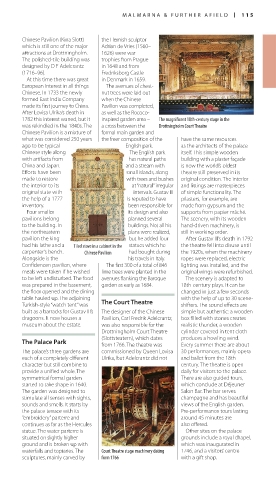
1782 this interest waned, but it inspired garden area – The magnificent 18th-century stage in the
was rekindled in the 1840s. The a cross between the Drottningholm Court Theatre
Chinese Pavilion is a mixture of formal main garden and
what was considered 250 years the freer composition of the have the same resources
ago to be typical English park. as the architects of the palace
Chinese style along The English park itself. This simple wooden
with artifacts from has natural paths building with a plaster façade
China and Japan. and a stream with is now the world’s oldest
Efforts have been small islands, along theatre still preserved in its
made to restore with trees and bushes original condition. The interior
the interior to its at “natural” irregular and fittings are masterpieces
original state with intervals. Gustav III of simple functionality. The
the help of a 1777 is reputed to have pilasters, for example, are
inventory. been responsible for made from gypsum and the
Four smaller its design and also supports from papier mâché.
pavilions belong planned several The scenery, with its wooden
to the building. In buildings. Not all his handdriven machinery, is
the northeastern plans were realized, still in working order.
pavilion the king but he added four After Gustav III’s death in 1792
had his lathe and a Tiled stove in a cabinet in the statues which he the theatre fell into disuse until
carpenter’s bench. Chinese Pavilion had bought during the 1920s, when the machinery
Alongside is the his travels in Italy. ropes were replaced, electric
Confidencen pavilion, where The first 300 of a total of 846 lighting was installed, and the
meals were taken if he wished lime trees were planted in the original wings were refurbished.
to be left undisturbed. The food avenues flanking the Baroque The scenery is adapted to
was prepared in the basement, garden as early as 1684. 18thcentury plays. It can be
the floor opened and the dining changed in just a few seconds
table hauled up. The adjoining with the help of up to 30 scene
Turkishstyle “watch tent” was The Court Theatre shifters. The sound effects are
built as a barracks for Gustav III’s The designer of the Chinese simple but authentic: a wooden
dragoons. It now houses a Pavilion, Carl Fredrik Adelcrantz, box filled with stones creates
museum about the estate. was also responsible for the realistic thunder, a wooden
Drottningholm Court Theatre cylinder covered in tent cloth
(Slottsteatern), which dates produces a howling wind.
The Palace Park from 1766. The theatre was Every summer there are about
The palace’s three gardens are commissioned by Queen Lovisa 30 performances, mainly opera
each of a completely different Ulrika, but Adelcrantz did not and ballet from the 18th
character but still combine to century. The theatre is open
provide a unified whole. The daily for visitors to the palace.
symmetrical formal garden There are also guided tours,
started to take shape in 1640. which conclude at Déjeuner
The garden was designed to Salon Bar. The bar serves
stimulate all senses with sights, champagne and has beautiful
sounds and smells. It starts by views of the English garden.
the palace terrace with its Preperformance tours lasting
“embroidery” parterre and around 45 minutes are
continues as far as the Hercules also offered.
statue. The water parterre is Other sites on the palace
situated on slightly higher grounds include a royal chapel,
ground and is broken up with which was inaugurated in
waterfalls and topiaries. The Court Theatre stage machinery dating 1746, and a visitors’ centre
sculptures, mainly carved by from 1766 with a gift shop.
114-115_EW_Sweden.indd 115 11/07/16 11:48 am

