


Page 50 - (DK Eyewitness) Travel Guide - Sweden
P. 50
48 INTRODUCING SWEDEN
Universal Suffrage king had to accept a government which
Sweden’s population reached 5 million contained republican-friendly Social
around 1900, despite mass emigration Democrats, including the future prime
to America. Many people moved to the minister, Hjalmar Branting. By then it was
towns to work in industry, and by the parliament, not the king, that decided what
early 20th century Stockholm’s population sort of government Sweden should have.
was about 300,000, a fourfold increase
since the year 1800. The Growth of the Welfare State
Increasing social awareness and In 1936 the Social Democrats
the rise of the Social Democrat and and Farmers’ Party formed a
Liberal parties in the early 20th coalition which developed
century gave impetus to the what was to become known as
demands for universal suffrage. the welfare state. The Social
Authors such as August Strindberg Democrat prime minister, Per
became involved. A political battle Albin Hansson (1885–1946),
ensued which was not resolved defined the welfare state as a
until 1921, when universal suffrage socially conscious society with
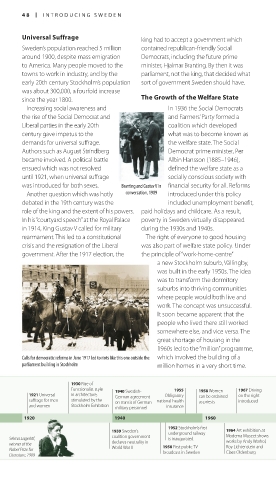
was introduced for both sexes. Branting and Gustav V in financial security for all. Reforms
Another question which was hotly conversation, 1909 introduced under this policy
debated in the 19th century was the included unemployment benefit,
role of the king and the extent of his powers. paid holidays and childcare. As a result,
In his “courtyard speech” at the Royal Palace poverty in Sweden virtually disappeared
in 1914, King Gustav V called for military during the 1930s and 1940s.
rearmament. This led to a constitutional The right of everyone to good housing
crisis and the resignation of the Liberal was also part of welfare state policy. Under
government. After the 1917 election, the the principle of “work-home-centre”
a new Stockholm suburb, Vällingby,
was built in the early 1950s. The idea
was to transform the dormitory
suburbs into thriving communities
where people would both live and
work. The concept was unsuccessful.
It soon became apparent that the
people who lived there still worked
somewhere else, and vice versa. The
great shortage of housing in the
1960s led to the “million” programme,
Calls for democratic reforms in June 1917 led to riots like this one outside the which involved the building of a
parliament building in Stockholm million homes in a very short time.
1930 Rise of
Functionalist style 1940 Swedish- 1955 1958 Women 1967 Driving
1921 Universal in architecture, German agreement Obligatory can be ordained on the right
suffrage for men stimulated by the on transit of German national health as priests introduced
and women Stockholm Exhibition military personnel insurance
1920 1940 1960
1952 Stockholm’s first
1939 Sweden’s underground railway 1964 Art exhibition at
coalition government Moderna Museet shows
Selma Lagerlöf, is inaugurated works by Andy Warhol,
winner of the declares neutrality in 1950 First public TV Roy Lichtenstein and
Nobel Prize for World War II broadcast in Sweden Claes Oldenburg 1973 Gustav VI Adolf dies and is succeeded
Literature, 1909 by his grandson, Carl XVI Gustaf
048-049_EW_Sweden.indd 48 11/07/16 11:43 am
Eyewitness Travel LAYERS PRINTED:
History Portrait template “UK” LAYER
(Source v1.2)
Date 20th August 2012
Size 125mm x 217mm

