


Page 49 - (DK Eyewitness) Travel Guide - Sweden
P. 49
THE HIST OR Y OF SWEDEN 47
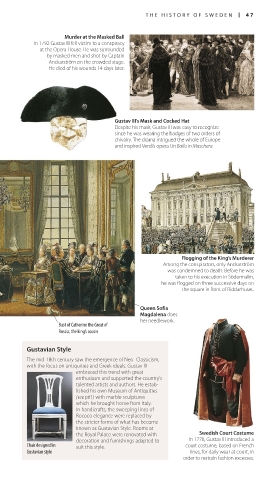
Murder at the Masked Ball
In 1792 Gustav III fell victim to a conspiracy
at the Opera House. He was surrounded
by masked men and shot by Captain
Anckarström on the crowded stage.
He died of his wounds 14 days later.
Gustav III’s Mask and Cocked Hat
Despite his mask, Gustav III was easy to recognize
since he was wearing the badges of two orders of
chivalry. The drama intrigued the whole of Europe
and inspired Verdi’s opera Un Ballo in Maschera.
Flogging of the King’s Murderer
Among the conspirators, only Anckarström
was condemned to death. Before he was
taken to his execution in Södermalm,
he was flogged on three successive days on
the square in front of Riddarhuset.
Queen Sofia
Magdalena does
her needlework.
Bust of Catherine the Great of
Russia, the king’s cousin
Gustavian Style
The mid-18th century saw the emergence of Neo- Classicism,
with the focus on antiquities and Greek ideals. Gustav III
embraced this trend with great
enthusiasm and supported the country’s
talented artists and authors. He estab-
lished his own Museum of Antiquities
(see p61) with marble sculptures
which he brought home from Italy.
In handicrafts, the sweeping lines of
Rococo elegance were replaced by
the stricter forms of what has become
known as Gustavian Style. Rooms at
the Royal Palace were renovated with Swedish Court Costume
decoration and furnishings adapted to In 1778, Gustav III introduced a
Chair designed in suit this style. court costume, based on French
Gustavian style lines, for daily wear at court, in
order to restrain fashion excesses.
046-047_EW_Sweden.indd 47 11/07/16 11:48 am

