


Page 107 - (DK) I Can’t Believe It! 2
P. 107
IT CAN’T BE TRUE!  105

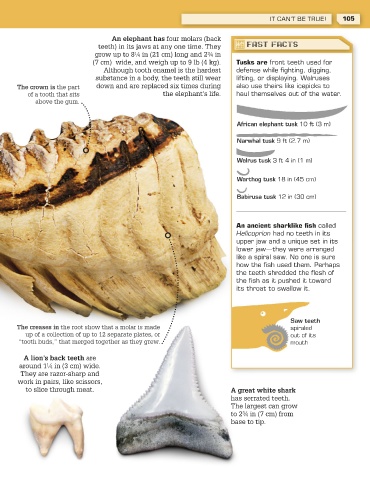
                          An elephant has four molars (back
                       teeth) in its jaws at any one time. They   FAST FACTS
                       grow up to 8¼ in (21 cm) long and 2¾ in
                      (7 cm)  wide, and weigh up to 9 lb (4 kg).   Tusks are front teeth used for
                         Although tooth enamel is the hardest   defense while fighting, digging,
                       substance in a body, the teeth still wear   lifting, or displaying. Walruses
     The crown is the part   down and are replaced six times during   also use theirs like icepicks to
       of a tooth that sits           the elephant’s life.  haul themselves out of the water.
         above the gum.

                                                       African elephant tusk 10 ft (3 m)
                                                       Narwhal tusk 9 ft (2.7 m)

                                                       Walrus tusk 3 ft 4 in (1 m)

                                                       Warthog tusk 18 in (45 cm)
                                                       Babirusa tusk 12 in (30 cm)


                                                       An ancient sharklike fish called
                                                       Helicoprion had no teeth in its
                                                       upper jaw and a unique set in its
                                                       lower jaw—they were arranged
                                                       like a spiral saw. No one is sure
                                                       how the fish used them. Perhaps
                                                       the teeth shredded the flesh of
                                                       the fish as it pushed it toward
                                                       its throat to swallow it.


                                                                   Saw teeth
     The creases in the root show that a molar is made             spiraled
       up of a collection of up to 12 separate plates, or          out of its
     “tooth buds,” that merged together as they grew.              mouth
      A lion’s back teeth are
     around 1¼ in (3 cm) wide.
      They are razor-sharp and
     work in pairs, like scissors,
       to slice through meat.                        A great white shark
                                                     has serrated teeth.
                                                     The largest can grow
                                                     to 2¾ in (7 cm) from
                                                     base to tip.


   US_104_105_309600_ICBT_How_Big_Elephant_Teeth.indd   105               19/12/17   2:35 pm

