


Page 261 - (DK) I Can’t Believe It! 2
P. 261
TRUE OR FALSE?  259
     Your irises    Sight is the most important sense, enabling    FAST FACTS

      us to view the world. Light from exterior objects
      is automatically focused onto a layer of light
 are as unique    receptors at the back of the eye. These receptors   THE EYE CAN
                                                      DISTINGUISH BETWEEN
      then send messages to the brain about the
                                                      UP TO 10 MILLION
      patterns of light. The brain interprets these
      messages, enabling us to see 3-D, moving
 as your fingerprints  color images of what is going on around us.  DIFFERENT COLORS
                                                                    Optic nerve carries nerve

                                                                  signals from retina to the brain
                                                            Iris
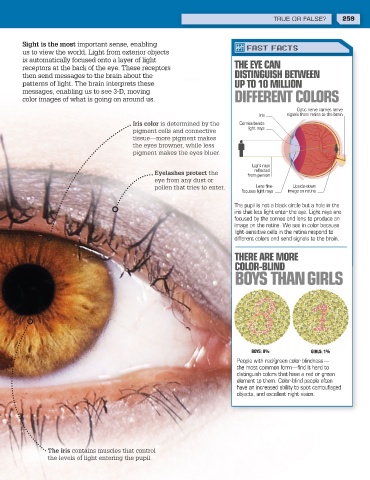
                               Iris color is determined by the
                                                         light rays
                               pigment cells and connective   Cornea bends
                               tissue—more pigment makes
                               the eyes browner, while less
                               pigment makes the eyes bluer.
                                                          Light rays
                                                           reflected
                                    Eyelashes protect the    from person
                                    eye from any dust or
                                    pollen that tries to enter.  Lens fine-   Upside-down
                                                        focuses light rays  image on retina
                                                      The pupil is not a black circle but a hole in the
                                                      iris that lets light enter the eye. Light rays are
                                                      focused by the cornea and lens to produce an
                                                      image on the retina. We see in color because
                                                      light-sensitive cells in the retina respond to
                                                      different colors and send signals to the brain.
                                                      THERE ARE MORE
                                                      COLOR-BLIND
                                                      BOYS THAN GIRLS


                                                          BOYS: 8%      GIRLS: 1%
                                                       People with red/green color blindness—
                                                       the most common form—find it hard to
                                                       distinguish colors that have a red or green
                                                       element to them. Color-blind people often
                                                       have an increased ability to spot camouflaged
                                                       objects, and excellent night vision.


            The iris contains muscles that control
            the levels of light entering the pupil.


   US_258_259_309600_Eyes.indd   259                                      19/12/17   3:48 pm

