


Page 291 - (DK) I Can’t Believe It! 2
P. 291
TRUE OR FALSE?  289

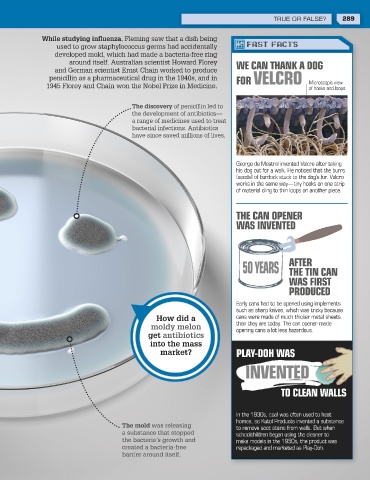
           While studying influenza, Fleming saw that a dish being
              used to grow staphylococcus germs had accidentally   FAST FACTS
             developed mold, which had made a bacteria-free ring
                 around itself. Australian scientist Howard Florey    WE CAN THANK A DOG
             and German scientist Ernst Chain worked to produce
            penicillin as a pharmaceutical drug in the 1940s, and in   FOR VELCRO
            1945 Florey and Chain won the Nobel Prize in Medicine.     Microscopic view
                                                                       of hooks and loops
                               The discovery of penicillin led to
                               the development of antibiotics—
                               a range of medicines used to treat
                               bacterial infections. Antibiotics
                               have since saved millions of lives.


                                                       George de Mestral invented Velcro after taking
                                                       his dog out for a walk. He noticed that the burrs
                                                       (seeds) of burdock stuck to the dog’s fur. Velcro
                                                       works in the same way—tiny hooks on one strip
                                                       of material cling to thin loops on another piece.

                                                       THE CAN OPENER
                                                       WAS INVENTED


                                                        50 YEARS   AFTER
                                                                   THE TIN CAN
                                                                   WAS FIRST
                                                                   PRODUCED
                                                       Early cans had to be opened using implements
                                                       such as sharp knives, which was tricky because
                                    How did a          cans were made of much thicker metal sheets
                                   moldy melon         than they are today. The can opener made
                                   get antibiotics     opening cans a lot less hazardous.
                                   into the mass
                                     market?           PLAY-DOH WAS
                                                         INVENTED


                                                                 TO CLEAN WALLS

                                                       In the 1930s, coal was often used to heat
                                                       homes, so Kutol Products invented a substance
                             The mold was releasing    to remove soot stains from walls. But when
                             a substance that stopped    schoolchildren began using the cleaner to
                             the bacteria’s growth and   make models in the 1950s, the product was
                             created a bacteria-free    repackaged and marketed as Play-Doh.
                             barrier around itself.


   US_288_289_309600_Inventions.indd   289                                19/12/17   3:49 pm

