


Page 35 - World of Animals - Issue #33
P. 35
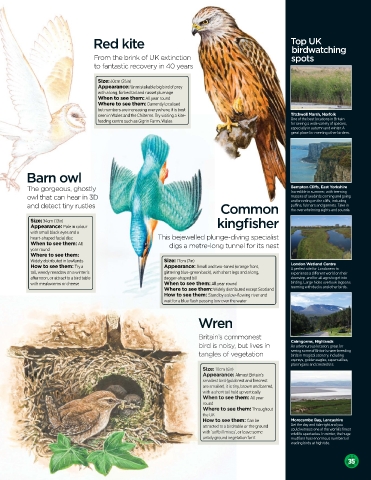
Red kite Top UK
birdwatching
From the brink of UK extinction spots
to fantastic recovery in 40 years
Size: 60cm (24in)
Appearance: Unmistakable big bird of prey
with a long, forked tail and russet plumage
When to see them: All year round
Where to see them: Currently localised
but numbers are increasing everywhere; it is best
seen in Wales and the Chilterns. Try visiting a kite- Titchwell Marsh, Norfolk
feeding centre such as Gigrin Farm, Wales One of the best locations in Britain
for seeing a wide variety of species,
especially in autumn and winter. A
great place for meeting other birders.
Barn owl
The gorgeous, ghostly Bempton Cliffs, East Yorkshire
Incredible in summer, with teeming
owl that can hear in 3D masses of seabirds coming and going
and breeding on the cliffs, including
and detect tiny rustles Common puffi ns, fulmars and gannets. Take in
the overwhelming sights and sounds.
Size: 34cm (13in) kingfi sher
Appearance: Pale in colour
with small black eyes and a
heart-shaped facial disc This bejewelled plunge-diving specialist
When to see them: All digs a metre-long tunnel for its nest
year round
Where to see them:
Widely distributed in lowlands Size: 17cm (7in) London Wetland Centre
How to see them: Try a Appearance: Small and two-toned (orange front, A perfect site for Londoners to
tall, weedy meadow on a winter’s glittering blue-green back), with short legs and a long, experience a different world on their
aernoon, or attract to a bird table dagger-shaped bill doorstep, and for all ages to get into
with mealworms or cheese When to see them: All year round birding. Large hides overlook lagoons
teeming with ducks and other birds.
Where to see them: Widely distributed except Scotland
H o w t o s e e t h e m : S t a n d b y a s l o w - fl o w i n g r i v e r a n d
How to see them: Stand by a slow-flowing river and
w o
a
h
a
g l
e
o
s
e
t
e w
r a b
o
l
e fl
u
w
wait for a blue flash passing low over the water r
a
t f
i
s
v
r t
n
i
a
s
h p
n
Wr
e
Wren
i
a
B
t
t
Britain’s commonest
es
i
r
omm
on
n
’
s
c
bird is noisy, but lives in
bird is noisy, but lives in Cairngorms, Highlands
An adventurous location, great for
tangles of vegetation
tangles of vegetation seeing some of Britain’s rarer breeding
birds in magical scenery, including
ospreys, golden eagles, capercaillies,
ptarmigans and crested tits.
S i ze : 1 0 c m ( 4 i n )
Size: 10cm (4in)
A p p ea r a n c e: A l m o s t B r i t a i n ’ s
Appearance: Almost Britain’s
s
t a
s
smallest bird (goldcrest and firecrest t
t b
l
i
r
o
c
e
d
a
r
s
l
r
d fi
d (
e
s
l
e
r
c
m
n
e
g
t
s
i
d
b
a
n
a
e
d
r
r
y
,
i
n
b
w
n
r
o
)
r
e
s
e
m
r
l
l
a
i
a are smaller), it is tiny, brown and barred, ,
t
,
w i t h a s h o r t t a i l h e l d u p v e r t i c a l l y
with a short tail held up vertically
W h e n t o s e e t h e m :
When to see them: All year
ro u n
roundd
W h e r e t o s e e t h e m :
Where to see them: Throughout
K
e U
h
t
the UK
H o w t o s e e t h e m : Morecambe Bay, Lancashire
How to see them: Can be
a
e
d t
e g
o
c
r
r t
h
t
r
b
d
n
d t
a attracted to a bird table or the ground Get the day and tide right and you
a
o a b
r
u
i
e o
l
t
t
could witness one of the world’s finest
o
t
i
e
w
h ‘
m
with ‘sobill mixes’, or leave some wildlife spectacles. In winter, the huge
b
, o
r l
’
l m
xe
i
i
s
l
a
o
s
e s
v
e
g
i
u
o
y g
d
d v
r i
e
n
e
r
a
n f
t
n
u untidy ground vegetation for it t mudflats host enormous numbers of
t
t
o
o
i
wading birds at high tide.
35

