


Page 37 - World of Animals - Issue #33
P. 37
A beginner’s guide to birdwatching


                                                   How to attract birds to your garden


                                                   You can start birdwatching just by looking out of the window. Many birds
                                                   visit gardens, and you can affect their number and variety in several ways


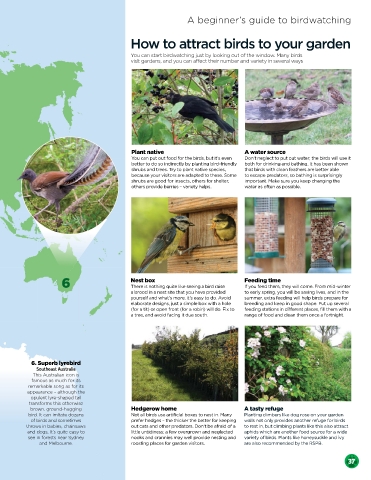
                                                   Plant native                            A water source
                                                   You can put out food for the birds, but it’s even   Don’t neglect to put out water; the birds will use it
                                                   better to do so indirectly by planting bird-friendly   both for drinking and bathing. It has been shown
                                                   shrubs and trees. Try to plant native species,   that birds with clean feathers are better able
                                                   because your visitors are adapted to these. Some   to escape predators, so bathing is surprisingly
                                                   shrubs are good for insects, others for shelter,   important. Make sure you keep changing the
                                                   others provide berries – variety helps.  water as often as possible.


                                                   Nest box                                Feeding time
                                                   There is nothing quite like seeing a bird raise   If you feed them, they will come. From mid-winter
                                                   a brood in a nest site that you have provided   to early spring, you will be saving lives, and in the
                                                   yourself and what’s more, it’s easy to do. Avoid   summer, extra feeding will help birds prepare for
                                                   elaborate designs, just a simple box with a hole   breeding and keep in good shape. Put up several

                                                   (for a tit) or open front (for a robin) will do. Fix to   feeding stations in different places, fill them with a
                                                   a tree, and avoid facing it due south.  range of food and clean them once a fortnight.


                6. Superb lyrebird
                  Southeast Australia
                 This Australian icon is
                famous as much for its
               remarkable song as for its
               appearance – although the
                opulent lyre-shaped tail
               transforms this otherwise
                brown, ground-hugging              Hedgerow home                           A tasty refuge

               bird. It can imitate dozens         Not all birds use artificial boxes to nest in. Many   Planting climbers like dog rose on your garden
                of birds and sometimes             prefer hedges – the thicker the better for keeping   walls not only provides another refuge for birds
              throws in babies, chainsaws          out cats and other predators. Don’t be afraid of a   to rest in, but climbing plants like this also attract
               and dogs. It’s quite easy to        little untidiness; a few overgrown and neglected   aphids which are another food source for a wide
               see in forests near Sydney          nooks and crannies may well provide nesting and   variety of birds. Plants like honeysuckle and ivy
                   and Melbourne.                  roosting places for garden visitors.    are also recommended by the RSPB.

                                                                                                                               37

