


Page 41 - World of Animals - Issue #33
P. 41
Eastern mountain bongo
The decreasing population
The areas highlighted on the map show the only remaining populations
of eastern mountain bongo in the world. These animals are split into four
highly fragmented populations by geographical constraints.
Kenya
Territory in 2016
Battling for bongos
Keepers at Woburn Safari Park have been working
with the EEP (European Endangered Species
Programme) on conservation and breeding activity
for the eastern mountain bongo.
Although eastern mountain bongos boast a striking appearance,
spiralling horns and a long flexible tongue, by nature, they are shy
animals that prefer to remain out of sight during the day.
Poaching has been a key factor for the decline of populations
and as a result they are now completely extinct in some areas.
They are also susceptible to diseases, such as rinderpest, which
in the 1980s almost exterminated the species.
Lindsay Banks, Senior Keeper at Woburn Safari Park said:
“The EEP works closely with Woburn and in-fi eld conservation
organisations to raise attention, provide expertise, pair individuals
to ensure healthy reserve numbers in the captive population,
and assist in vital genetic studies of captive and wild populations.
Currently, the wild population is genetically impoverished, and if
le alone, could be less able to adapt to environmental changes
in the future. Management of captive and wild individuals aims to
halt the current loss of genetic diversity and safeguard the species
from extinction.”
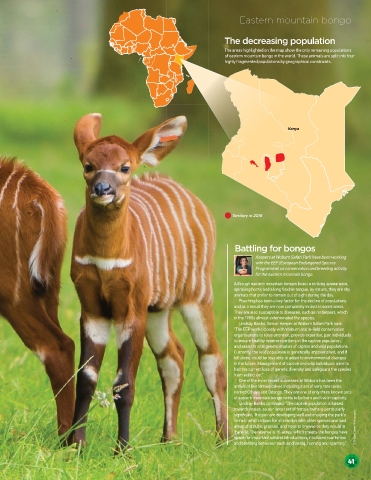
One of the most recent successes at Woburn has been the
arrival of five female calves including a set of very rare twins,
named Othaya and Odongo. They are one of only three known sets
of eastern mountain bongo twins to be born and live in captivity.
Lindsay Banks continued: “The captive population is biased
towards males, so our latest set of female twins is particularly
significant. The pair are developing well and enjoying the park’s
terrain, which allows for interaction with other species and vast
areas of shrubs, grasses, and trees to browse as they would in © Bridget Davey Photography
the wild. The reserve is 16-acres, which means the bongos have
space for important natural introductions, ritualised courtships
and breeding behaviour such as chasing, running and sparring.”
41

