


Page 16 - World of Animals - Issue #36
P. 16
30 amazing facts about bears
As intelligent as
great apes
Bears are often portrayed as simple animals – clumsy, cuddly,
lovable creatures bumbling around the forest on a never-
ending hunt for food.
But it may surprise you to know that some scientists rank
bears up there with the great apes, even boasting the same
intelligence as a three-year-old human child. Their intelligence
can be demonstrated purely by how curious they are, and they
will often stand on their hind legs to get a better view or have
a sniff of their surroundings. They love exploring and finding
objects to play with and treats to eat.
We often look to signs of tool use as a sign of intelligence,
and it’s a skill bears certainly aren’t lacking. The use of sticks
and branches to scratch their backs is often observed, and
even more complex problem solving was seen in the grizzly
bear who used a wooden plank as a bridge to cross a patch of
bramble and retrieve a coke can it had spotted.
Despite all this, they are lacking spatial awareness, not
always taking into account what is going on around them, and
they can be easily distracted by food. Once they have found
a meal they become engrossed, completely oblivious to their
surroundings. That’s why it’s best to make your presence
known when walking through the woods, so you don’t catch a
bear unawares.
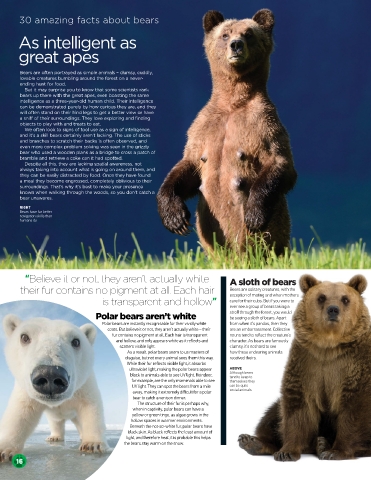
RIGHT
Bears have far better
navigation skills than
humans do
“Believe it or not, they aren’t actually white – A sloth of bears
t
s
f b
l
o
r
h o
a
A s
e
their fur contains no pigment at all. Each hair Bears are solitary creatures, with the
r
s a
r
a
s
e
e
, w
y c
a
t
i
r
r
e
l
e s
r
u
a
o
t
i
h
e
B
h t
t
e
h
t
d w
x
n
e
t
h
c
f m
p
a
r
g a
n o
n m
n
i
s
e
o
i
t
o
e
is transparent and hollow” exception of mating and when mothers
i
f y
r t
h
o
e t
r
e
t i
r c
a
u w
u
b
care for their cubs. But if you were to
c
s
. B
e
o
o
e f
r
u
u
o
r
r
a
p o
f b
e
e a g
e
n
k
g a
i
s t
e
a
v
r s
e ever see a group of bears taking a
u w
d
h t
l
r
t
o
r
e
o
o
h
l
t
r
e f
o
o
h
, y
u
g
l t
u
s
Polar bears aren’t white s stroll through the forest, you would
be seeing a sloth of bears. Apart
b
p
h o
r
a
t
f b
e s
a
e
e
s
n
r
g a s
i
t
e
l
. A
o
n t
h
e
a
y
s
e
, t
h
d
n
t
n i
s p
’
e
o
r
h
m w
a
Polar bears are instantly recognisable for their vividly white f from when it’s pandas, then they
o
t
e a
r
b
e
coats. But believe it or not, they aren’t actually white – their are an embarrassment. Collective
t
. C
n e
i
a
m
m
v
n
r
e
r
c
e
s
a
l
s
l
a
u
t
n
a
r
e
e
o
u
r
s
o r
’
d t
h
e
c
t t
fl
fur contains no pigment at all. Each hair is transparent n nouns tend to reflect the creature’s
e
e c
s t
n
e
and hollow, and only appears white as it reflects and character. As bears are famously
s
y
l
c
u
o
t
s a
e
c
a
r
a
. A
s b
r
e
a
r
e f
r
a
h
m
clumsy, it’s not hard to see
scatters visible light. clumsy, it’s not hard to see
As a result, polar bears seem to us masters of how these endearing animals
how these endearing animals
received theirs.
disguise, but not every animal sees them this way. received theirs.
While their fur reflects visible light, it absorbs
ABOVE
ultraviolet light, making the polar bears appear ABOVE
Although bears
black to animals able to see UV light. Reindeer, Although bears
tend to keep to
tend to keep to
for example, are the only mammals able to see themselves they
themselves they
can be quite
UV light. They can spot the bears from a mile can be quite
social animals
away, making it extremely diffi cult for a polar social animals
bear to catch a venison dinner.
The structure of their fur is perhaps why,
when in captivity, polar bears can have a
yellow or green tinge, as algae grows in the
hollow spaces in warmer environments.
Beneath the not-so-white fur, polar bears have
black skin. As black reflects the least amount of
light, and therefore heat, it is probable this helps
the bears stay warm on the snow.
16
014-022_30 amazing facts about bears.indd 16 20/07/2016 15:13

