


Page 29 - World of Animals - Issue #36
P. 29
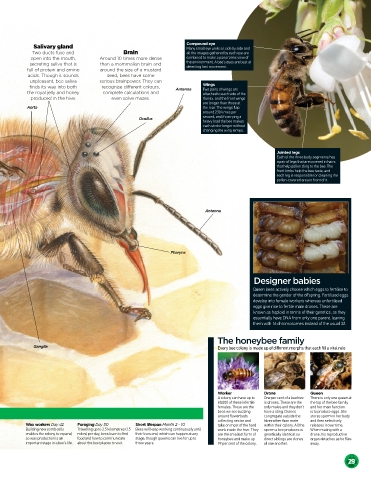
The honeybee


                 Salivary gland                                        Compound eye
                                                                       Many small eye units sit side by side and
                 Two ducts fuse and              Brain                 all the images gathered by each eye are
                open into the mouth,    Around 10 times more dense     combined to make a panoramic view of
                secreting saliva that is   than a mammalian brain and   the environment. A bee’s eyes are best at
               full of protein and amino   around the size of a mustard   detecting fast movement.
               acids. Though it sounds     seed, bees have some
                unpleasant, bee saliva   serious brainpower. They can
                finds its way into both   recognise different colours,       Wings
               the royal jelly and honey   complete calculations and   Antenna  Two pairs of wings are
                                                                            attached to each side of the
                produced in the hive.       even solve mazes.               thorax, and the front wings
                                                                            are longer than those at
               Aorta                                                        the rear. The wings flap
                                                                            around 230 times per
                                                                            second, and if carrying a
                                                      Ocellus
                                                                            heavy load the bee makes
                                                                            each stroke longer without
                                                                            changing the wing tempo.

                                                                                                      Jointed legs
                                                                                                      Each of the three body segments has
                                                                                                      a pair of legs that are covered in hairs
                                                                                                      that help pollen cling to the bee. The
                                                                                                      front limbs help the bee taste, and
                                                                                                      each leg is responsible for cleaning the
                                                                                                      pollen-covered area in front of it.


                                                                             Antenna


                                                                 Pharynx


                                                                                              Designer babies
                                                                                              Queen bees actively choose which eggs to fertilise to
                                                                                              determine the gender of the offspring. Fertilised eggs
                                                                                              develop into female workers whereas unfertilised
                                                                                              eggs give rise to fertile male drones. These are
                                                                                              known as haploid in terms of their genetics, as they
                                                                                              essentially have DNA from only one parent, leaving
                                                                                              them with 16 chromosomes instead of the usual 32.

                                                                                  The honeybee family
                 Ganglia                                                          Every bee colony is made up of different morphs that each fill a vital role


                                                                                  Worker          Drone           Queen
                                                                                  A colony can have up to   One per cent of a beehive   There is only one queen at
                                                                                  80,000 of these infertile   is drones. These are the   the top of the bee family
                                                                                  females. These are the   only males and they don’t   and her main function
                                                                                  bees we see buzzing   have a sting. Drones   is to produce eggs. She
                                                                                  around flowerbeds   congregate outside the   stores sperm in her body
                                                                                  collecting nectar and   hive rather than mate   and then selectively
              Wax workers Day 42  Foraging Day 50    Short lifespan Month 2 - 10  take on most of the hard   within their colony. All the   releases it over time.
              Building new comb cells   Travelling up to 2.5 kilometres (1.5  Bees will keep working continuously until   work inside the hive. They   sperm a bee produces is   When mating with a
              enables the colony to expand,  miles) per day, bees learn to find   their lives end, which can happen at any   are the smallest form of   genetically identical so   drone, his reproductive
              so wax production is an   food and how to communicate   stage, though queens can live for up to   honeybee and make up   direct siblings are clones   organ detaches as he flies
              important stage in a bee’s life.  about the best places to visit.  three years.  99 per cent of the colony.   of one another.  away.

                                                                                                                               29


       024-031_AA Honeybees.indd   29                                                                                        20/07/2016   15:20

