


Page 27 - World of Animals - Issue #36
P. 27
The honeybee
The dance of the honeybees The more vigorous the dance, the richer the
These insects don’t need words to communicate and like tango source of food is. This tells the other bees if it
is worth the effort of visiting the new feeding
dancers they allow their moves to do the talking ground, especially if it is a long way away.
Fragments of pollen on the dancer’s antennae give
surrounding bees a taste of what’s ahead. However, it
seems bees are subject to the fear of the unknown as 93
per cent of bees will return to familiar food sources even
aer witnessing a waggle dance.
When a honeybee wants to tell The steps are relatively simple, though While it may look subtle, each aspect of the
others about the location of new food they convey a complex message. The bee dance contains vital information. The longer
sources it performs a short dance. It moves in a figure-of-eight pattern and the waggling continues, the further away the A dancing bee can even wordlessly communicate the
takes place near the hive entrance to takes a straight path in between loops. All food source. Those watching the performance direction in which the rest of the colony has to travel. The
allow observing workers to take flight the while the dancing bee flutters its wings are able to understand the exact distance from angle of the waggle walk relates to the sun’s position,
as soon as it has finished. while the rest of the workers watch. the duration of the dance alone. allowing onlookers to detect which direction to travel.
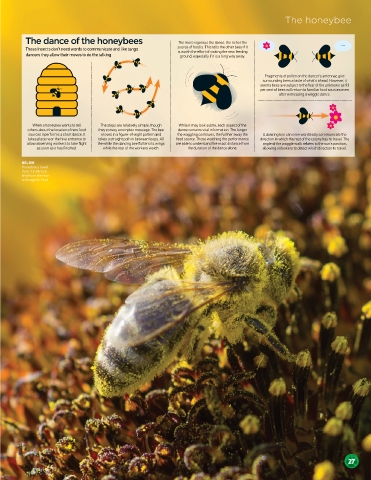
BELOW
Honeybees travel
from 3.2-8km (2-
5m) from the hive
to forage for food
27
024-031_AA Honeybees.indd 27 20/07/2016 14:27

