


Page 34 - Wine Spectator (January 2020)
P. 34
W
                                                                 W I N E   F O C U SI N E   F O C U S


                   After the Gold Rush


                   Canadian producers are ushering in a new era of quality north of the border


                   BY BRUCE SANDERSON

                                                                                                      Ontario’s wine regions of Niagara Peninsula, Lake Erie North Shore
                             ver the past decade, the wines of Canada reached a new level  and Prince Edward County benefit from the cold-mitigating influence
                             in terms of quality, style and consistency. Chalk that up to in-      of Lake Ontario and Lake Erie, which decrease the severity of winter
                             vestment on the part of talented, passionate vintners, who are  weather in the area. Combined with the limestone and sedimentary

                   Oplanting more vinifera grape varieties and exploring vineyard-                 soils of the old lake beds, these conditions set the stage for high qual-
                   designated reds and whites.                                                     ity viticulture.
                     This evolution was borne out in my recent blind tastings of more than            The Niagara Peninsula is further divided into 10 subappellations un-
                   100 wines from Ontario and British Columbia. Overall, 40% of the  der the VQA. The cooler areas in the western and southern parts of the
                   wines earned outstanding ratings of  90 points

                   or  higher  on  Wine  Spectator’s  100-point
                   scale—an impressive showing compared with
                   our previous reviews of Canadian wines, dat-
                   ing back to the 1990s, only 20% of which

                   rated outstanding. Furthermore, ice wine, the
                   sweet dessert wine made from frozen grapes,
                   no longer dominates the top-scoring bot-
                   tlings. Chardonnay, Pinot Noir, Merlot and
                   red blends are showing comparable success.

                     “I truly believe in Ontario and, in particu-
                   lar, our very unique vineyard on the Niagara
                   Escarpment bench,” says Flat Rock Cellars
                   president  Ed  Madronich,  whose  Gravity

                   Twenty Mile Bench 2015 (92 points, $35),
                   made from Pinot Noir, is one of this report’s
                   top-scoring  wines.  “The  combination  of
                   Mother Nature—soil and climate—and a
                   talented group of passionate individuals al-
                   lows me to know we can not only stand out

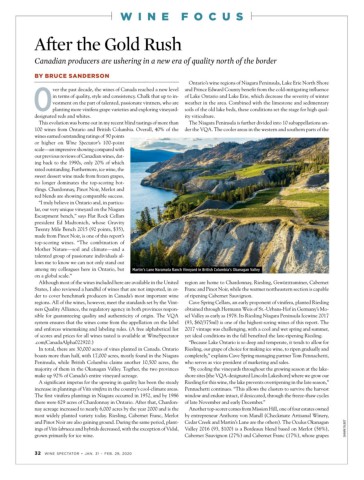
                   among my colleagues here in Ontario, but             Martin’s Lane Naramata Ranch Vineyard in British Columbia’s Okanagan Valley
                   on a global scale.”
                     Although most of the wines included here are available in the United  region are home to Chardonnay, Riesling, Gewürztraminer, Cabernet
                   States, I also reviewed a handful of wines that are not imported, in or-        Franc and Pinot Noir, while the warmer northeastern section is capable

                   der to cover benchmark producers in Canada’s most important wine  of ripening Cabernet Sauvignon.
                   regions. All of the wines, however, meet the standards set by the Vint-            Cave Spring Cellars, an early proponent of vinifera, planted Riesling
                   ners Quality Alliance, the regulatory agency in both provinces respon-          obtained through Hermann Weis of St.-Urbans-Hof in Germany’s Mo-
                   sible for guaranteeing quality and authenticity of origin. The VQA   sel Valley as early as 1978. Its Riesling Niagara Peninsula Icewine 2017
                   system ensures that the wines come from the appellation on the label  (93, $60/375ml) is one of the highest-soring wines of this report. The

                   and enforces winemaking and labeling rules. (A free alphabetical list  2017 vintage was challenging, with a cool and wet spring and summer,
                   of scores and prices for all wines tasted is available at WineSpectator  yet ideal conditions in the fall benefited the late-ripening Riesling.
                   .com/CanadaAlpha022920.)                                                           “Because Lake Ontario is so deep and temperate, it tends to allow for
                     In total, there are 30,000 acres of vines planted in Canada. Ontario  Riesling, our grape of choice for making ice wine, to ripen gradually and

                   boasts more than half, with 17,000 acres, mostly found in the Niagara  completely,” explains Cave Spring managing partner Tom Pennachetti,
                   Peninsula, while British Columbia claims another 10,500 acres, the  who serves as vice president of marketing and sales.
                   majority of them in the Okanagan Valley. Togther, the two provinces                “By cooling the vineyards throughout the growing season at the lake-
                   make up 92% of Canada’s entire vineyard acreage.                                shore sites [the VQA-designated Lincoln Lakeshore] where we grow our
                     A significant impetus for the upswing in quality has been the steady  Riesling for this wine, the lake prevents overripening in the late season,”

                   increase in plantings of Vitis vinifera in the country’s cool-climate areas.  Pennachetti continues. “This allows the clusters to survive the harvest
                   The first vinifera plantings in Niagara occurred in 1952, and by 1986  window and endure intact, if desiccated, through the freeze-thaw cycles
                   there were 629 acres of Chardonnay in Ontario. After that, Chardon-             of late November and early December.”
                   nay acreage increased to nearly 6,000 acres by the year 2000 and is the            Another top-scorer comes from Mission Hill, one of four estates owned

                   most widely planted variety today. Riesling, Cabernet Franc, Merlot  by entrepreneur Anthony von Mandl (Checkmate Artisanal Winery,
                   and Pinot Noir are also gaining ground. During the same period, plant-          Cedar Creek and Martin’s Lane are the others). The Oculus Okanagan
                   ings of Vitis labrusca and hybrids decreased, with the exception of Vidal,  Valley 2016 (93, $100) is a Bordeaux blend based on Merlot (56%),                         SHAWN TALBOT
                   grown primarily for ice wine.                                                   Cabernet Sauvignon (27%) and Cabernet Franc (17%), whose grapes


                   32    WINE  SPECTATOR  •  JAN.  31  –  FEB.  29,  2020

