


Page 16 - Forbes - Asia (October 2019)
P. 16
THOUGHT LEADERS                                                        YUWA HEDRICK-WONG // ECONOMICS MATTERS


           Dangerous Addiction


                                                  he first step in rehabili-
                                                  tating an alcoholic is to
                                                  get them to admit that
                                       Tthey are an alcohol-
                                        ic. The same is true for curing the
                                        addiction to cheap money in an
                                        economy. Today, Europe, Japan
                                        and the U.S. are dangerously ad-
                                        dicted to cheap money. Not only
                                        is there no admission of the ad-
                                        diction, these economies’ cen-
           tral banks are set to indefinitely maintain low or zero interest
           rates. As a consequence, about one-quarter of sovereign and
           corporate bonds worldwide, Bloomberg data shows, are trad-
           ing with an implied yield below zero.
              The U.S. Federal Reserve’s failure to normalize rates il-
           lustrates this addiction. The Fed started raising interest rates
           in December 2015, after keeping its benchmark Fed Funds
           Rate at 0.25% (effectively zero) for seven years. By December
           2018, it had climbed to 2.5%, about half of what it was be-
           fore the global financial crisis. But even such a low rate was
           deemed too high for the fragile U.S. economy. On July 31,
           the Fed cut the rate by a quarter of a percentage point, fol-
           lowed by another similar cut on September 19, signalling the
           end of normalization.                                               Loose monetary policy
              The European Central Bank (ECB) didn’t even bother               is extremely harmful
           with normalization. The ECB is holding its refinancing rate         to economies.
           at zero and, on September 12, cut its deposit rate from -0.4%
           to -0.5% (yes, negative 0.5%). It will also restart its quanta-
           tive easing program, even though it holds an unprecedented
           amount of government debts in its book.                             rates be 5% instead of zero, German savers would earn
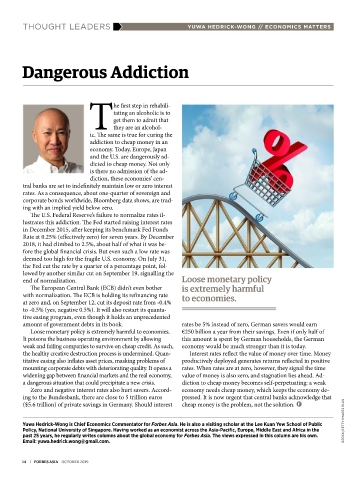
              Loose monetary policy is extremely harmful to economies.         €250 billion a year from their savings. Even if only half of
           It poisons the business operating environment by allowing           this amount is spent by German households, the German
           weak and failing companies to survive on cheap credit. As such,     economy would be much stronger than it is today.
           the healthy creative destruction process is undermined. Quan-           Interest rates reflect the value of money over time. Money
           titative easing also inflates asset prices, masking problems of     productively deployed generates returns reflected in positive
           mounting corporate debts with deteriorating quality. It opens a     rates. When rates are at zero, however, they signal the time
           widening gap between financial markets and the real economy,        value of money is also zero, and stagnation lies ahead. Ad-
           a dangerous situation that could precipitate a new crisis.          diction to cheap money becomes self-perpetuating: a weak
              Zero and negative interest rates also hurt savers. Accord-       economy needs cheap money, which keeps the economy de-
           ing to the Bundesbank, there are close to 5 trillion euros          pressed. It is now urgent that central banks acknowledge that
                                                                                                                                                     ISTOCK/GETTY IMAGES PLUS
           ($5.6 trillion) of private savings in Germany. Should interest      cheap money is the problem, not the solution. F


           Yuwa Hedrick-Wong is Chief Economics Commentator for Forbes Asia. He is also a visiting scholar at the Lee Kuan Yew School of Public
           Policy, National University of Singapore. Having worked as an economist across the Asia-Pacific, Europe, Middle East and Africa in the
           past 25 years, he regularly writes columns about the global economy for Forbes Asia. The views expressed in this column are his own.
           Email: yuwa.hedrick.wong@gmail.com.


           14     |     FORBES ASIA     OCTOBER 2019

