


Page 20 - Forbes - Asia (October 2019)
P. 20
ENTREPRENEURS


              Restrictions by Beijing and Can-           the new housing stock in New South           as now, due to a leasing strategy that
           berra were meant to crimp demand. In          Wales, the state in which Sydney is lo-      provides profits when demand is weak.
           2015, on concerns that international de-      cated and where Meriton is most active,      During a similar downturn in the 1970s,
           mand was making home prices unaf-             according to Credit Suisse.                  Triguboff offset lower sales for Meriton’s
           fordable for its citizens, the Australian        Purchases from Chinese investors          new apartments by keeping some of its
           government limited nonresident inves-         have declined more recently as Aus-          dwellings and renting them out rath-
           tors to purchasing newly built proper-        tralian regulators increased taxes and       er than selling them. To this day, Meri-
           ties, vacant land or residences still on      stamp duty on foreign buyers, more           ton retains ownership of slightly more
           the drawing board, or “off-plan.” Inter-      than doubling surcharges in some in-         than a tenth of the dwellings it builds, a
           national buyers face other restrictions:      stances. Simultaneously, the Chinese         roughly A$3 billion portfolio of proper-
           approval from the Foreign Investment          government introduced stricter cap-          ties that makes Meriton Australia’s big-
           Review Board for their purchase; up to                                                     gest landlord. So when property pric-
           40% deposit on purchase prices before                                                      es rise, so does Triguboff’s net worth;
           banks will give a mortgage; and various  Triguboff does well                               when the market is volatile, his rent-

           fees, taxes and stamp duties.                                                              al income is the backstop. “Leasing is a
              Despite the barriers, Australian           even in rare downturns                       huge area for us and one where we are
           property remains attractive to interna-       in Australian property.                      growing,” he says.
           tional buyers, particularly from China,                                                        Meriton’s yield income is helped by
           who want to safely park funds offshore                                                     its strategy to build projects in suburbs
           in an appreciating asset. Wealthy Chi-        ital controls to reduce renminbi out-        close to the central business district
           nese can also take advantage of Austra-       flows. But Triguboff says that no matter     that command premium rents, accord-
           lia’s investor visa schemes, a pathway to     how difficult Beijing or Canberra make       ing to Michelle Ciesielski, head of res-
           permanent residency for those willing         it, Chinese buyers will remain attract-      idential research at Knight Frank Aus-
           to bankroll Australian-based enterpris-       ed to Australian property. “The Chinese      tralia. “This increased rental supply has
           es. The Significant Investor Visa, requir-    always know how to find the way to           certainly aided locals wanting to live
           ing an investment of A$5 million (not         overcome anything,” he says. “So even        close to where they work and play,” she
           including real estate), has been granted      though our banks may not give them           says. While other developers have the
           2,022 times since the scheme’s inception      much money, and maybe their govern-          same strategy, Meriton retains a higher
           in 2012, with 87% of recipients being         ment doesn’t let them take much money        portion of its own units than others for
           mainland Chinese, according to Aus-           [out of China], they usually find a way      rent, she says.
           tralia’s Department of Home Affairs.          to invest.”                                      Triguboff is confident the market will
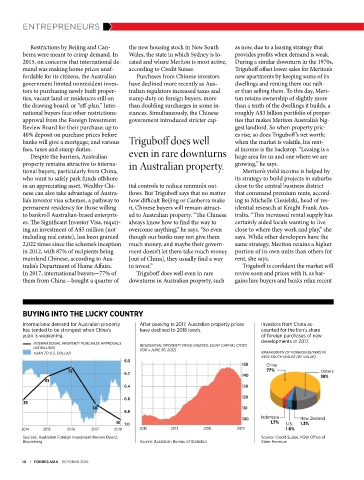
           In 2017, international buyers—77% of             Triguboff does well even in rare          revive soon and prices with it, as bar-
           them from China—bought a quarter of           downturns in Australian property, such       gains lure buyers and banks relax recent


           BUYING INTO THE LUCKY COUNTRY

           International demand for Australian property      After peaking in 2017, Australian property prices    Investors from China ac-
           has tended to be strongest when China’s           have declined to 2016 levels.                        counted for the lion’s share
           yuan is weakening.                                                                                     of foreign purchases of new
                                                                                                                  developments in 2017.
               INTERNATIONAL PROPERTY PURCHASE APPROVALS     RESIDENTIAL PROPERTY PRICE INDEXES: EIGHT CAPITAL CITIES
               (A$ BILLION)
                                                             (100 = JUNE 30, 2012)
               YUAN TO U.S. DOLLAR                                                                                BREAKDOWN OF FOREIGN BUYERS IN
                                                                                                                  NEW SOUTH WALES (BY VALUE)
                                                       6.0
                                                                                                          150       China
                              72                                                                                    77%                    Others
                                                       6.2
                                                                                                          140                              18%
                     61
                                                       6.4                                                130


                                                       6.6                                                120
           35
                                         30                                                               110
                                                       6.8
                                                                                                                 Indonesia
                                                                                                          100                      New Zealand
                                                   13  7.0                                                            1.7%  U.S.   1.3%
          2014      2015      2016      2017      2018       2010          2013          2016          2019                 1.6%
           Sources: Australian Foreign Investment Review Board,                                                   Source: Credit Suisse, NSW Office of
           Bloomberg                                         Source: Australian Bureau of Statistics              State Revenue


           18     |     FORBES ASIA     OCTOBER 2019

