


Page 24 - Forbes - Asia (October 2019)
P. 24
ENTREPRENEURS


           began operating only 31 months ago thanks to almost $1 bil-
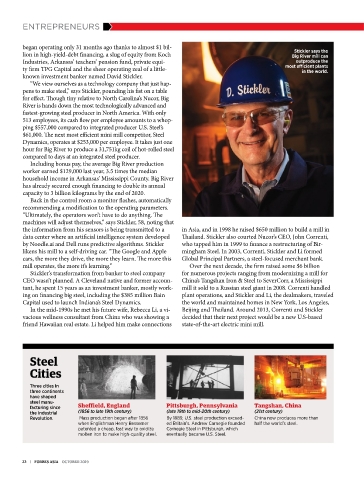
                                                                                                                                Stickler says the
           lion in high-yield-debt financing, a slug of equity from Koch                                                       Big River mill can
           Industries, Arkansas’ teachers’ pension fund, private equi-                                                           outproduce the
                                                                                                                            most efficient plants
           ty firm TPG Capital and the sheer operating zeal of a little-
                                                                                                                                   in the world.
           known investment banker named David Stickler.
              “We view ourselves as a technology company that just hap-
           pens to make steel,” says Stickler, pounding his fist on a table
           for effect. Though tiny relative to North Carolina’s Nucor, Big
           River is hands down the most technologically advanced and
           fastest-growing steel producer in North America. With only
           513 employees, its cash flow per employee amounts to a whop-
           ping $557,000 compared to integrated producer U.S. Steel’s
           $61,000. The next most efficient mini mill competitor, Steel
           Dynamics, operates at $253,000 per employee. It takes just one
           hour for Big River to produce a 31,751kg coil of hot-rolled steel
           compared to days at an integrated steel producer.
              Including bonus pay, the average Big River production
           worker earned $129,000 last year, 3.5 times the median
           household income in Arkansas’ Mississippi County. Big River
           has already secured enough financing to double its annual
           capacity to 3 billion kilograms by the end of 2020.
              Back in the control room a monitor flashes, automatically
           recommending a modification to the operating parameters.
           “Ultimately, the operators won’t have to do anything. The
           machines will adjust themselves,” says Stickler, 58, noting that
           the information from his sensors is being transmitted to a          in Asia, and in 1998 he raised $650 million to build a mill in
           data center where an artificial intelligence system developed       Thailand. Stickler also courted Nucor’s CEO, John Correnti,
           by Noodle.ai and Dell runs predictive algorithms. Stickler          who tapped him in 1999 to finance a restructuring of Bir-
           likens his mill to a self-driving car. “The Google and Apple        mingham Steel. In 2003, Correnti, Stickler and Li formed
           cars, the more they drive, the more they learn. The more this       Global Principal Partners, a steel-focused merchant bank.
           mill operates, the more it’s learning.”                                 Over the next decade, the firm raised some $6 billion
              Stickler’s transformation from banker to steel company           for numerous projects ranging from modernizing a mill for
           CEO wasn’t planned. A Cleveland native and former accoun-           China’s Tangshan Iron & Steel to SeverCorr, a Mississippi
           tant, he spent 15 years as an investment banker, mostly work-       mill it sold to a Russian steel giant in 2008. Correnti handled
           ing on financing big steel, including the $385 million Bain         plant operations, and Stickler and Li, the dealmakers, traveled
           Capital used to launch Indiana’s Steel Dynamics.                    the world and maintained homes in New York, Los Angeles,
              In the mid-1990s he met his future wife, Rebecca Li, a vi-       Beijing and Thailand. Around 2013, Correnti and Stickler
           vacious wellness consultant from China who was showing a            decided that their next project would be a new U.S-based
           friend Hawaiian real estate. Li helped him make connections         state-of-the-art electric mini mill.


              Steel

              Cities


              Three cities in
              three continents
              have shaped
              steel manu-
              facturing since      Sheffield, England                    Pittsburgh, Pennsylvania              Tangshan, China
              the Industrial       (1856 to late 19th century)           (late 19th to mid-20th century)       (21st century)
              Revolution.           Mass production began after 1856     By 1889, U.S. steel production exceed-  China now produces more than
                                   when Englishman Henry Bessemer        ed Britain’s. Andrew Carnegie founded   half the world’s steel.
                                   patented a cheap, fast way to oxidize   Carnegie Steel in Pittsburgh, which
                                   molten iron to make high-quality steel.  eventually became U.S. Steel.


           22     |     FORBES ASIA     OCTOBER 2019

