


Page 67 - Forbes - Asia (October 2019)
P. 67
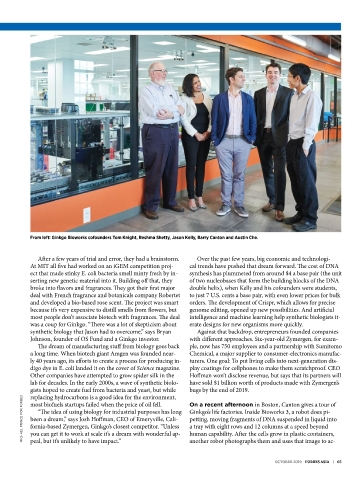
From left: Ginkgo Bioworks cofounders Tom Knight, Reshma Shetty, Jason Kelly, Barry Canton and Austin Che.


                 After a few years of trial and error, they had a brainstorm.         Over the past few years, big economic and technologi-
              At MIT all five had worked on an iGEM competition proj-              cal trends have pushed that dream forward. The cost of DNA
              ect that made stinky E. coli bacteria smell minty fresh by in-       synthesis has plummeted from around $4 a base pair (the unit
              serting new genetic material into it. Building off that, they        of two nucleobases that form the building blocks of the DNA
              broke into flavors and fragrances. They got their first major        double helix), when Kelly and his cofounders were students,
              deal with French fragrance and botanicals company Robertet           to just 7 U.S. cents a base pair, with even lower prices for bulk
              and developed a bio-based rose scent. The project was smart          orders. The development of Crispr, which allows for precise
              because it’s very expensive to distill smells from flowers, but      genome editing, opened up new possibilities. And artificial
              most people don’t associate biotech with fragrances. The deal        intelligence and machine learning help synthetic biologists it-
              was a coup for Ginkgo. “There was a lot of skepticism about          erate designs for new organisms more quickly.
              synthetic biology that Jason had to overcome,” says Bryan               Against that backdrop, entrepreneurs founded companies
              Johnson, founder of OS Fund and a Ginkgo investor.                   with different approaches. Six-year-old Zymergen, for exam-
                 The dream of manufacturing stuff from biology goes back           ple, now has 750 employees and a partnership with Sumitomo
              a long time. When biotech giant Amgen was founded near-              Chemical, a major supplier to consumer-electronics manufac-
              ly 40 years ago, its efforts to create a process for producing in-   turers. One goal: To put living cells into next-generation dis-
              digo dye in E. coli landed it on the cover of Science magazine.      play coatings for cellphones to make them scratchproof. CEO
              Other companies have attempted to grow spider silk in the            Hoffman won’t disclose revenue, but says that its partners will
              lab for decades. In the early 2000s, a wave of synthetic biolo-      have sold $1 billion worth of products made with Zymergen’s
              gists hoped to create fuel from bacteria and yeast, but while        bugs by the end of 2019.
              replacing hydrocarbons is a good idea for the environment,
            MICHAEL PRINCE FOR FORBES  been a dream,” says Josh Hoffman, CEO of Emeryville, Cali-  Ginkgo’s life factories. Inside Bioworks 3, a robot does pi-
              most biofuels startups failed when the price of oil fell.
                                                                                   On a recent afternoon in Boston, Canton gives a tour of
                 “The idea of using biology for industrial purposes has long
                                                                                   petting, moving fragments of DNA suspended in liquid into
              fornia-based Zymergen, Ginkgo’s closest competitor. “Unless
                                                                                   a tray with eight rows and 12 columns at a speed beyond
                                                                                   human capability. After the cells grow in plastic containers,
              you can get it to work at scale it’s a dream with wonderful ap-
                                                                                   another robot photographs them and uses that image to ac-
              peal, but it’s unlikely to have impact.”


                                                                                                                        OCTOBER 2019     FORBES ASIA     |     65

