


Page 71 - Forbes - Asia (October 2019)
P. 71
valuation suggests investors expect his       try). “I always knew back then, [with]
              approach to make a big score, starting        those businesses, that I would be in and
              with cancer, then against chronic condi-      out,” he says. In 2014, Lefkofsky’s wife,
              tions like depression and diabetes. But       Liz, was diagnosed with breast cancer.
              precision medicine is a nascent field.        “I was just perplexed at how little data
              Tempus, on its own or with a research         had permeated her care,” he says. That           DEAL THYSELF
              partner, has published fewer than 20          experience ultimately launched Tem-
              peer-reviewed manuscripts since its           pus. (Liz has “been taking it one day at         In 2010, Eric Lefkofsky, Andrew Mason
                                                                                                             and Brad Keywell’s Groupon was the
              founding four years ago. A competitor,        a time,” Lefkofsky says.)
                                                                                                             hottest company in America. Reel-
              sequencing firm Foundation Medicine,             Yet again, Lefkofsky needed data.             ing in consumers with bargains and
              has published over 400 in 9 years.            But some researchers were initially hes-         freebies, though, is a long, proud tra-
                 While the cost of sequencing has           itant to share. “They wanted us to basi-         dition. Some early examples of now-
              dropped, it still runs $1,000 to $5,000       cally send all our samples there for all         common tactics:
              per analysis, and Tempus loses money          our patients” in the future, says John           Coupon: In the 1890s, Coca-Cola own-
              doing it. Tempus also licenses its library    McPherson, deputy director of the Uni-           er Asa Candler created tickets good
              of anonymized data to drug companies,         versity of California, Davis Compre-             for a free fountain drink. Between
                                                                                                             1894 and 1913, one in nine Americans
              insurers and researchers. Lefkofsky           hensive Cancer Center. “But we took
                                                                                                             took Coke up on it.
              won’t reveal revenues, but says it gets       a more cautious approach.” They ran
              seven-figure fees from seven of the ten       a head-to-head comparison involving              Loyalty Card: As far back as the
                                                                                                             1920s, stamped metal tokens were the
              largest cancer drug companies.                gastrointestinal cancer between Tem-
                                                                                                             frequent-consumer discounts of their
                 Lefkofsky got the entrepreneur-            pus and Foundation Medicine; Tempus              day. During the Depression, Procter &
              ial bug at the University of Michigan,        fared well.                                      Gamble introduced tokens redeem-
              where he studied history and made                In 2017 Tempus reached a licens-              able for laundry soap.
              money selling carpets. In 2001, he co-        ing agreement with the American Soci-            Rewards Program: From the 1930s to
              founded InnerWorkings (marketing),            ety of Clinical Oncology to extract and          the 1980s, the Sperry & Hutchinson
              then Echo Global Logistics (transporta-       organize data from 1 million patient re-         company printed stamps available at
                                                                                                             stores and gas stations. The more you
              tion) and Mediaocean (advertising soft-       cords. Today the company says it al-
                                                                                                             spent, the more stamps—redeemable
              ware). One of Lefkofsky’s hires, Andrew       ready works with 30% of U.S. oncolo-             for assorted gewgaws—you received.
              Mason, pitched an idea for a business         gists; many send patient records and
                                                                                                             Flash Sale: Kmart introduced the
              focused on “collective action.” Lefkof-       biopsies to Tempus for analysis. Tem-
                                                                                                             Bluelight Special in 1965—literally a
              sky invested $1 million in what became        pus hopes to sequence 120,000 genomic            colored light bulb that signaled an im-
              Groupon. A year after its 2008 found-         samples for doctors this year.                   mediate 15-minute sale on goods in
              ing, it booked $14.5 million in revenue;         Even with that data, Tempus faces             certain areas of the store. The last
              in 2011, it generated $1.6 billion.           stiff competition. Last year Swiss drug          Bluelight went out in 1991 before the
                                                                                                             gimmick returned in the 2000s.
                 Lefkofsky spent a few years dabbling       giant Roche spent $4.3 billion acquiring
              on other projects, including Uptake           Foundation Medicine and big data firm
              (predictive analytics for heavy indus-        Flatiron Health. Another startup, Con-
                                                                                                          certo HealthAI, backed by billionaire
                                                                                                          Romesh Wadhwani, has access to many
                                                                                                          of the same records as Tempus.
                                                                                                             Doctors at UC Davis, McPherson
                                                                                                          says, have only sent about 100 sam-
                                                                                                          ples to Tempus, considerably fewer than
                                                                                                          they’ve sent to Foundation. “I think
                                                                                                          they were a little baffled by the amount
                                                                                                          of data that came back [from Tempus],”
                                                                                                          McPherson says. Clinicians “tend to
                                                                                                          take the easier route just to save time.
                                                                                                          But there are several clinicians that are
                                                                                                          now working fairly closely on the re-
                                                                                                          search side with them.”
                                                                                                             Lefkofsky remains supremely opti-
                                                                                                          mistic. “It certainly feels like my entire
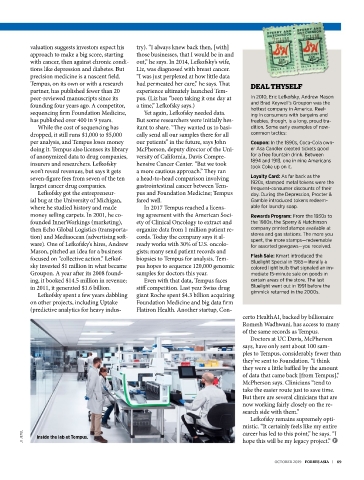
           JJ JETEL  Inside the lab at Tempus.                                                            career has led to this point,” he says. “I
                                                                                                          hope this will be my legacy project.” F


                                                                                                                       OCTOBER 2019     FORBES ASIA     |     69

