


Page 74 - Lighting & Sound America (December 2019) Magazine
P. 74
TECHNICAL FOCUS: TOOLS


                                                      Transmitter and the Multiverse Node  900MHz, but it was actually 2.4GHz,
                                                      as a receiver was very easy. I already  and I was using the omnidirectional
                                                      had the DMXcat app on my iPhone,  antennas that came with the units. If
                                                      and since the transmitter has a built-in  you need greater transmission dis-
                                                      DMXcat, I was able to connect it to my  tances, you can always use directional
                                                      phone via Bluetooth and discover it  antennas.
                                                      using RDM. It was so intuitive that I  The reception was strong and
                                                      never had to break out the user manu-  steady, despite the crowded frequency
                                                      al, with one small exception. When I  band. There are a few reasons for this.
                                                      accidentally connected a device to the  First, I was using the highest power
                                                      input of the node instead of the out-  setting. You can dial it down if you
                                                      put, it automatically went into transmit  don’t need to transmit over extremely
                                                      mode. I didn’t realize my mistake until  long distances and this will lessen the
                                                      I read the manual. As soon as I dis-  likelihood of interfering with other wire-
                                                      connected it, it went back into receive  less. This is an important feature in
                                                      mode.                             today’s production environments,
                                                        Then I walked it away from the  where other crews are working hard to
                                                      transmitter to see if I could get a signal  get their own wireless (audio, monitor-
                                                      in the middle of the trade show. At a  ing, lens focus, etc.) to work. Second,
                                                      distance of about 175', transmitting  Multiverse also has user-selectable
                                                      through dry wall and two sets of glass  adaptive spread spectrum rrequency
                                                      walls, the handy signal strength icon  hopping, which changes the transmis-
                                                      on the backlit LCD screen on the face  sion frequency several hundreds of
                                                      of the node was showing three out of  times every second, and it monitors
                                                      four bars, which means 50% or better.  the spectrum to avoid frequencies that
                                                      I thought I was using 900MHz but  have a lot of interference. Third, it uses
                                                      when I later looked at the pictures I  forward error correction.
                                                      took, I realized it was actually the  There are many more features in the
                                                      2.4GHz band. I would likely have got-  system; one of my favorites is the
                                                      ten much better results with 900MHz,  built-in Wi-Fi that allows you to con-
                                                      because the lower frequencies travel  nect to it to a tablet and use Luminair
                                                      farther and penetrate obstacles better  or any other tablet-based app to con-
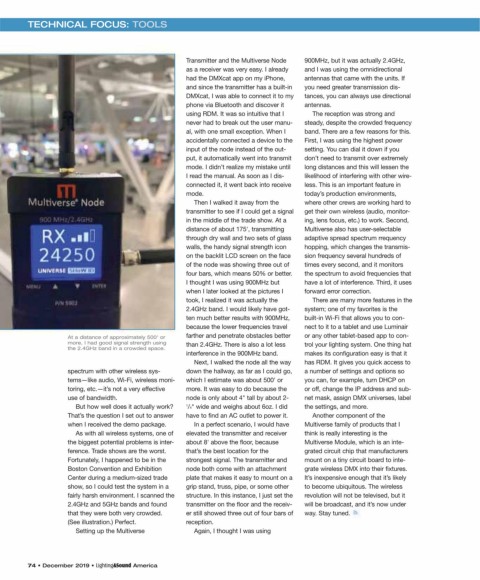
                    At a distance of approximately 500' or
                    more, I had good signal strength using  than 2.4GHz. There is also a lot less  trol your lighting system. One thing hat
                    the 2.4GHz band in a crowded space.
                                                      interference in the 900MHz band.  makes its configuration easy is that it
                                                        Next, I walked the node all the way  has RDM. It gives you quick access to
                    spectrum with other wireless sys-  down the hallway, as far as I could go,  a number of settings and options so
                    tems—like audio, Wi-Fi, wireless moni-  which I estimate was about 500' or  you can, for example, turn DHCP on
                    toring, etc.—it’s not a very effective  more. It was easy to do because the  or off, change the IP address and sub-
                    use of bandwidth.                 node is only about 4" tall by about 2-  net mask, assign DMX universes, label
                      But how well does it actually work?  1 /4" wide and weighs about 6oz. I did  the settings, and more.
                    That’s the question I set out to answer  have to find an AC outlet to power it.  Another component of the
                    when I received the demo package.   In a perfect scenario, I would have  Multiverse family of products that I
                      As with all wireless systems, one of  elevated the transmitter and receiver  think is really interesting is the
                    the biggest potential problems is inter-  about 8' above the floor, because  Multiverse Module, which is an inte-
                    ference. Trade shows are the worst.  that’s the best location for the  grated circuit chip that manufacturers
                    Fortunately, I happened to be in the  strongest signal. The transmitter and  mount on a tiny circuit board to inte-
                    Boston Convention and Exhibition  node both come with an attachment  grate wireless DMX into their fixtures.
                    Center during a medium-sized trade  plate that makes it easy to mount on a  It’s inexpensive enough that it’s likely
                    show, so I could test the system in a  grip stand, truss, pipe, or some other  to become ubiquitous. The wireless
                    fairly harsh environment. I scanned the  structure. In this instance, I just set the  revolution will not be televised, but it
                    2.4GHz and 5GHz bands and found   transmitter on the floor and the receiv-  will be broadcast, and it’s now under
                    that they were both very crowded.  er still showed three out of four bars of  way. Stay tuned.
                    (See illustration.) Perfect.      reception.
                      Setting up the Multiverse         Again, I thought I was using


         74 • December 2019 • Lighting& &Sound America

