


Page 76 - Lighting & Sound America (December 2019) Magazine
P. 76
TECHNICAL FOCUS: PRODUCT IN DEPTH


                    Sennheiser IE 500

                    PRO In-Ear Monitor


                    By: Mark Johnson


                    A few months ago, I had an opportuni-  and silicone ear adapters.
                    ty to review Sennheiser’s first pro IEM  Some of the innovations introduced
                    product, the IE 40 PRO. (Since then,  in the IE 40 are carried on through to
                    the company has followed up with the  the IE 500, notably the patent-applied-
                    release of the IE 400 PRO and IE 500  for cable-routing method for a secure
                    PRO in-ear monitor systems.) In the  and comfortable fit. The IE 500 carries
                    review, I stated that, based on my  on the relatively utilitarian look of the
                    experience with the IE 40, I was hop-  IE40, though the latter unit comes in
                    ing, at some point in the future, to try  opaque black or frosted clear, and the
                    out the IE 400. I need to be careful  IE 500 earpieces are available in clear
                    what I wish for. I ended up skipping  or “smokey black.” The IE 500 fea-
                    the IE 400 when I was offered an  tures the braided type of cable, desig-
                    opportunity to audition the top-of-the-  nated as “twisted pair,” compared to
                    line IE 500 PRO.                  the IE 40, in which all the wires are
                      The form factor of the three models  contained within the insulation. The
                    is very similar, and the specifications  cables (either style) are listed as
                    for the IE 400 and the IE 500 are very  optional accessories on the boxes of
                    close. The primary differences    both models. In each case, however,
                    between them is a frequency response  the majority of the listed optional
                    of 6Hz—20kHz for the IE 500, as   accessories are, in fact, included.
                    opposed to 6Hz—19kHz for the IE
                    400, and a maximum sound pressure  Keeping it simple
                    level of 126dB for the IE 500 com-  Compared to the multiple-driver IEMs
                    pared to 123dB for the IE 400. The IE  on the market, the IE 500 looks basic;
                    500 weighs in at a mere 18 grams;  it’s just a single 7mm driver. The interi-
                    sonically, it is a horse of a different  or of the earpiece is amazingly unclut-
                    color. It uses a SYS7 seven-millimeter  tered. The IE 500 (as well as the IE
                    dynamic driver and clocks in with less  400) utilizes a two-chamber absorber
                    than 0.08% total harmonic distortion.  to help reduce resonance peaks. The
                    With a good fit, you can expect about  method used to create the new 7mm
                    26dB of noise attenuation. The funda-  drivers has been dubbed
                    mental difference between the IE 400  “TrueResponse” technology. This is
                    and the IE 500, in terms of perform-  the marketing buzzword for the new
                    ance, is the mid-frequency response  driver and system, with the resultant
                    (with more “presence” in the mid fre-  low distortion and wide bandwidth,
                    quencies, between 1—2.5kHz), as well  which helps to create a natural sound-
                    as the ability to get 3dB louder, which  stage and reduce listener fatigue. The
                    is probably why the IE 500 is adver-  benefits of a single driver system are  ably few components, which combine
                    tised on the box as “the monitor engi-  full-bandwidth frequency response,  to make up the driver assembly. You
                    neer’s choice.”                   without the artifacts or distortion from  are basically looking at a miniaturized
                      The biggest visual distinction is,  multiple crossover points, and better  loudspeaker that has been fitted in the
                    actually, not the IEM proper; it’s the  phase response.             earpiece.
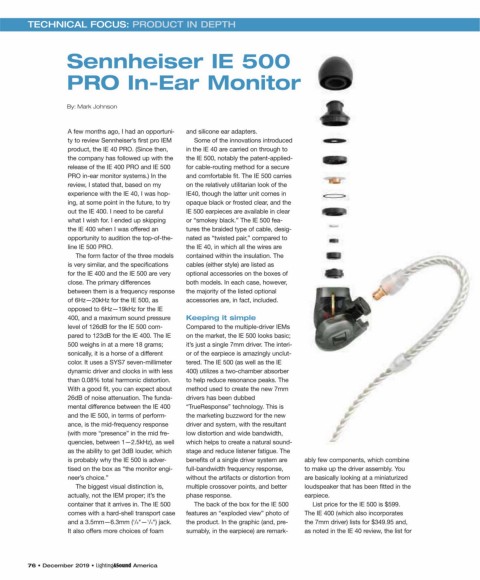
                    container that it arrives in. The IE 500  The back of the box for the IE 500  List price for the IE 500 is $599.
                    comes with a hard-shell transport case  features an “exploded view” photo of  The IE 400 (which also incorporates
                                       1
                                           1
                    and a 3.5mm—6.3mm ( /8"— /4") jack.  the product. In the graphic (and, pre-  the 7mm driver) lists for $349.95 and,
                    It also offers more choices of foam  sumably, in the earpiece) are remark-  as noted in the IE 40 review, the list for


         76 • December 2019 • Lighting& &Sound America

