


Page 22 - (DK Eyewitness) Travel Guide - Hungary
P. 22
20 INTRODUCING HUNGAR Y A POR TR AIT OF HUNGAR Y 21
10th century. Despite centuries of war, found, most strikingly in the mosque
occupation and the ever-present fear of at Pécs, now recycled as a Christian
being swallowed up by its neighbours, church, and in the towering minaret
Hungary and the Magyars survived at Eger, as well as in the handful of
and even flourished. Contemporary wonderfully preserved 16th-century
Hungarians remain extremely proud of thermal bath houses in Budapest.
their roots in the steppes of Asia, and Hungary also once had a thriving
they go to great lengths to preserve Jewish population, but it was deci-
their traditions. The dramatic displays mated during World War II, when
of horsemanship that take place on the most Jews were sent to concen tration
Puszta may be primarily for the benefit camps. Neglected synagogues still
of visitors but they also help retain a link found in many of Hungary’s cities
with the past, as does the enormous and towns are a testament to the
panoramic painting that fills the replica numbers who died.
tribal chieftain’s tent at Ópusztaszer, near An indoor pool at the Gellért Hotel and Baths complex Most Hungarians who profess any
Szeged, commemorating the arrival of the religion at all say they are Roman
The ruins of Csesznek castle, Bakony Mountains Magyars. The painting is dismissed by some that turn a sometimes difficult society, it Catholic (52 per cent). But religion in
as kitsch and unworthy of our time, yet it can be interpreted as aloofness, a desire Hungary has often been a question
and (often uneven) economic growth. plays an important role in preserving to keep “outsiders” (foreigners and other of expediency. Under King Stephen I
But while the scars of state socialism the spirit and memory of the nomadic Hungarians) at a distance. This is not Catholicism, as opposed to Orthodoxy,
remain – most notably in the bland Magyars. For better or worse, it is really the case; Hungarians simply need was introduced to the country and,
apartment blocks that encircle most Hungarian nationalism that has kept a while to make up their minds about while the majority of Hungarians were
cities – Hungarians are largely more the nation and the culture alive. people. There is also the language issue: quite happily Calvinists by the end of
affluent and optimistic than ever. Hungarian does not belong to the Indo- the 16th century, many donned a new
Culture and Society European language family, meaning mantle during the Counter-Reformation
National Origins Hungarians are very polite, formal people. that Russian and Hindi are closer to under the Habsburgs. As a result of
Most modern Hungarians trace their Older men still kiss women’s hands on English than Magyar is. It is part of the these swings, Hungarians tend to have
ancestry to the Magyars, an Asiatic people meeting and even close friends shake Finno-Ugric group, and due to millennia a prag matic view of religion and there is
of relatively obscure origins who arrived in hands when they get together. But while of separation it is not even mutually very little bigotry. Today, however, both
the region shortly before the start of the all this civility may help to oil the wheels intelligible with its closest cousins, Catholicism and Calvinism appear to be
Finnish and Estonian. As a result, visitors losing their influence as the country
will recognize few words, and trying to becomes more and more secular.
order a glass of vino in a bar gets you
nowhere; the word for wine is bor.
Few foreigners ever master Hungarian
completely, even after years of patient
study, and Hungarians themselves are
not particularly enthusiastic linguists.
English is, however, becoming more
popular as a second language, especially
among younger people in the cities.
The Magyars are not the only people
to have left their mark or helped form
modern Hungarian society. Germans
and Slovaks settled here as long ago as
the reign of King Stephen I (István) from
AD 1000 to 1038, and on the Great Plain
Balkan influences in the form of the
region’s lively markets can still be seen.
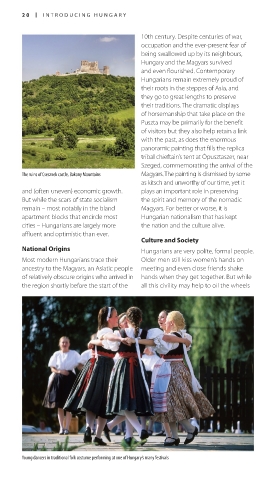
Young dancers in traditional folk costume performing at one of Hungary’s many festivals There are also Turkish footprints to be The symphony orchestra and state choir, Budapest
018-023_EW_Hungary.indd 20 18/09/17 3:39 pm 018-023_EW_Hungary.indd 21 14/11/2017 16:48

