


Page 27 - (DK Eyewitness) Travel Guide - Hungary
P. 27
A POR TR AIT OF HUNGAR Y 25
Hungarian Conservation
Magyars were once considered one of the great hunting
peoples of Europe, but in recent times their efforts have
been directed into conservation. As a result, all sorts of
species that were once teetering on the brink of extinction
are being preserved. Deer, wild boar, wolves and lynxes are
again commonly spotted in the Northern Mountains. The
National Forest Plantation Programme of 1997 has enhanced
the spread of forests and the saving of vulnerable wild
flowers. Hungary’s wetlands are a preferred destination for
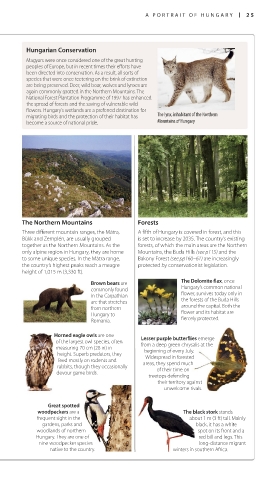
migrating birds and the protection of their habitat has The lynx, inhabitant of the Northern
become a source of national pride. Mountains of Hungary
The Northern Mountains Forests
Three different mountain ranges, the Mátra, A fifth of Hungary is covered in forest, and this
Bükk and Zemplén, are usually grouped is set to increase by 2035. The country’s existing
together as the Northern Mountains. As the forests, of which the main areas are the Northern
only alpine region in Hungary, they are home Mountains, the Buda Hills (see p115) and the
to some unique species. In the Mátra range, Bakony Forest (see pp160–61) are increasingly
the country’s highest peaks reach a meagre protected by conservationist legislation.
height of 1,015 m (3,330 ft).
Brown bears are The Dolomite flax, once
commonly found Hungary’s common national
in the Carpathian flower, survives today only in
arc that stretches the forests of the Buda Hills
from northern around the capital. Both the
Hungary to flower and its habitat are
Romania. fiercely protected.
Horned eagle owls are one Lesser purple butterflies emerge
of the largest owl species, often from a deep green chrysalis at the
measuring 70 cm (28 in) in beginning of every July.
height. Superb predators, they Widespread in forested
feed mostly on rodents and
rabbits, though they occasionally areas, they spend much
devour game birds. of their time on
treetops defending
their territory against
unwelcome rivals.
Great spotted
woodpeckers are a The black stork stands
frequent sight in the about 1 m (3 ft) tall. Mainly
gardens, parks and black, it has a white
woodlands of northern spot on its front and a
Hungary. They are one of red bill and legs. This
nine woodpecker species long-distance migrant
native to the country. winters in southern Africa.
Hun_24-25_ED084_FEAT.indd 25 17/02/2015 12:47

