


Page 71 - (DK Eyewitness) Travel Guide - Hungary
P. 71
C ASTLE DISTRIC T 69
much of their original medi eval s Hospital in
character. Almost all have some the Rock
remnant of a Gothic gate way Sziklakórház
or hall, while the façades are
Baroque or NeoClassical. Lovas út 4/c. Map 1 A5. Tel (70)
An excellent example of 701 01 01. @ 16 from Deák tér, 16,
a Gothic façade can be seen 16A & 116 from Széll Kálmán tér.
on Hölbling House at No. 31. Open 10am– 8pm daily. & 8
∑ sziklakorhaz.hu
Enough of its original features
survived the various wars and Connected to the network
renovations to enable archi tects of caves under Buda Castle,
to reconstruct the façade in the Hospital in the Rock is an
considerable detail. The first atmospheric sight where
floor window is a partic ularly visitors can learn about the
splendid Gothic feature. The history of Hungary through
houses opposite are also out the mid20th century.
examples of restoration work. In 1944–5 the caves were used
The façade of the Museum of The building at No. 53 was as an emergency military
Military History rebuilt between 1701 and 1722 hospital and airraid shelter,
as a Franciscan monastery, providing treatment and refuge
p Museum of but in 1789 it was restyled for for thousands of people during
Military History use by Emperor Joseph II. In the siege of Budapest. During
Hadtörténeti Múzeum 1795, Hungarian Jacobites, the revolution in 1956 it was
led by Ignác Martinovics, were again used as a hospital. A
Kapisztrán tér 2–4, entrance from Tóth imprisoned here; a plaque nuclear bunker was added
Árpád sétány. Map 1 A4. Tel (1) 325 16 records this event. A well, during the Cold War, the
00. @ 16 from Deák tér, 16, 16A & 116 featuring a copy of a sculpture existence of which was only
from Széll Kálmán tér. Open Apr–Sep:
10am–6pm Tue–Sun; Oct–Mar: 10am– by Praxiteles of Artemis, the made public in 2010.
4pm Tue–Sun. 8 ∑ militaria.hu Greek goddess of hunting, was Many pieces of the original
set in front of the house in 1873. medical equipment are on
The museum is located in a wing The Telephone Museum, display. There are present ations
of the former Palatine barracks. at No. 49, is housed in the on the history of the city,
It houses a wide range of military city’s first tele phone exchange, information on the 1956
items relating to the skirmishes established in 1881. It is an Revolution and the Cold War,
and wars that have afflicted enjoyable interactive museum, along with wax figures, all
Budapest from before the Turkish centred around a huge switch bringing this unique sight to
occu pation to the 20th century. board with exhibits on the life. The guided tour (approx.
Uniforms, flags, weapons, maps history of telephony. 60 mins) is compulsory.
and ammu nition from as far
back as the 11th century give an
insight into the long, turbulent
history of Budapest.
Of particular interest is
the exhibition concerning the
1956 Revolution. Photographs
illustrate the demonstrations
that ended in a Soviet invasion,
the execution of the prime
minister and a great number
of civilian deaths (see pp48–9).
a Lords’ Street
Úri utca
Map1 A4 – B5. @ 16 from Deák
tér, 16, 16A & 116 from Széll Kálmán
tér. Telephone Museum: Tel (30) 986
29 03. Open 10am–4pm Tue–Sun. &
∑ postamuzeum.hu
The buildings in Lords’ Street, or
Úri utca, were destroyed first in
1686 and again in 1944. Recon
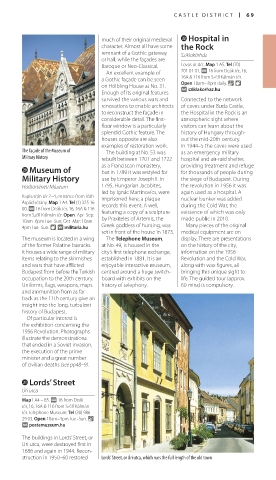
struction in 1950–60 restored Lords’ Street, or Úri utca, which runs the full length of the old town
068-069_EW_Hungary.indd 69 18/09/17 3:39 pm

