


Page 9 - (DK Eyewitness) Travel Guide - Hungary
P. 9
HOW T O USE THIS GUIDE 7
HUNGAR Y REGION B Y REGION 133
AROUND
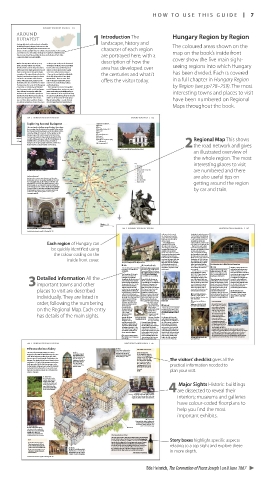
BUDAPEST Introduction The Hungary Region by Region
Strategically sited castles and vast cathedrals, 1landscape, history and
including Hungary’s largest, look out over the The coloured areas shown on the
pleasure boats navigating the Danube Bend. The character of each region
unique evening sunlight here has always attracted artists to the region,
and evidence of a rich cultural heritage is everywhere. Gödöllő boasts map on the book’s inside front
the stunning Royal Palace, while the Duna-Ipoly National Park offers are portrayed here, with a
a superb habitat for native wildlife.
description of how the cover show the five main sight
With its darting twists and turns, steep seeking respite today are the thousands
banks and deep valleys, the Danube of Budapest residents who keep holiday seeing regions into which Hungary
Bend has been a site of refuge for almost homes in the area, and the legions of area has developed over
2,000 years. Rome built garrisons here, and visitors on short trips from the capital –
there are remnants of that great empire a fact that is reflected in local prices. has been divided. Each is covered
everywhere. The natural fortress that is the Over on the east bank the rolling hills the centuries and what it
Danube’s west bank was later the chosen of the Börzsöny and the Duna-Ipoly
site for the construction of the historic National Park – home to more than in a full chapter in Hungary Region
towns of Visegrád and Esztergom, both half of Hungary’s native bird species – offers the visitor today.
built with protection and defence in mind. make for sensational hiking, walking
Esztergom was the scene of the Hungarian and birdwatching. by Region (see pp128–259). The most
conversion to Christianity, and Visegrád This is perhaps the most cosmopolitan
was the impenetrable seat of royal power. part of Hungary, where visitors can expect
Later still came Szentendre, which, like warm, welcoming and multilingual hosts, interesting towns and places to visit
Ráckeve to the south of the capital, was but in summer it can be very hot and busy.
founded by Serbs fleeing persecution at As autumn usually brings plenty of rain and
home and, though few Serbs remain, winter can be very cold, the early spring –
traces of their culture and their religion March, April and May – may be the best have been numbered on Regional
are evident everywhere. Those who come time for exploring these historic places.
Maps throughout the book.
134 HUNGAR Y REGION B Y REGION AROUND BUD APEST 135
Exploring Around Budapest Sights at a Glance
2 Ócsa
The countryside and villages around Budapest have always 1 Ráckeve
been a major draw for visitors to the capital. To the north is 3 Gödöllő p136 & pp138–9
the Danube Bend (Dunakanyar), and in the middle of it the 4 Vácrátót
art-loving village of Szen tendre. Further upriver are the 5 Vác
Baroque town of Vác and Hungary’s most sacred city, 6 Szentendre pp142–4
7 Visegrád
Esztergom. Beyond, the Duna-Ipoly National Park offers
Magnificent frescoes in the Serbian Orthodox Church in Ráckeve DUNA-IPOLY 8 Zebegény Regional Map This shows
countless hiking and nature trails. The Royal Mansion in
9 Nagybörzsöny & Duna-Ipoly
Gödöllő to the east is worth seeing, and south of
Statue of István, the first Hungarian king, at Esztergom – the site of his coronation NAGYBÖRZSÖNY NATIONAL PARK National Park
Budapest are the pretty town of Ráckeve and the Ócsa 0 Esztergom pp146–9
Nature Reserve, a unique habitat of reedy bogs. 2the road network and gives
ZEBEGÉNY The Royal Palace in Gödöllő, built by Count Antal Grassalkovich
Kosd
ESZTERGOM an illustrated overview of
VISEGRÁD
VÁC
Komárom the whole region. The most
Leányfalu
Dorog VÁCRÁTÓT
SZENTENDRE Göd Debrecen
Key
Veresegyház Aszód interesting places to visit
Pomáz Dunakeszi Motorway
Pilisvörösvar Major road
Beautiful waterlilies in the marshes around Ócsa Fót GÖDÖLLŐ Tura Major road under construction are numbered and there
Solymár Duna (Danub e) Secondary road
Zsámbék Csömör Kerepes Minor road
Getting Around Győr Kistarcsa Isaszeg Main railway are also useful tips on
Budapest has an international airport, and from here Budakeszi Minor railway
destinations such as Szentendre, Gödöllő and Ócsa are International border
best reached by train, on the Budapest sub urban rail Pécel Jászberény Regional border
network (HÉV, see p310). Other sightseeing areas can be Biatorbágy Budaörs BUDAPEST getting around the region
visited by train or car. During the summer months, the Törökbálint Sülysáp
most relaxing way to reach the Danube Bend is by Mahart Gyömrő
Passnave motor boat, departing north wards from Vigadó Vecsés by car and train.
tér in Buda pest. Services run to Esztergom and stop at Érd Gyál
most towns along the way. Other services go to Székes- Üllő
Szentendre and Vác. fehérvár Szigetszent- Monor
miklós
Szigethalom
Százhalom-
batta
Dunavarsány ÓCSA Inárcs Szolnok
Ráckevei-Duna PEST
Ercsi
Kiskunlacháza Bugyi Dabas Újhartyán
RÁCKEVE
Kecskemét
Dömsöd
Dunaúj- Kalocsa
város
0 kilometres 10
0 miles 10
A statue of Justice, crowning the Baroque
town hall in Vác Y REGION B Y REGION
Inside Esztergom Basilica, centre of Catholicism in Hungary 166 HUNGAR NOR THERN TR ANSD ANUBIA 167
For hotels and restaurants see pp264–269 and pp276–285 For additional keys to symbols see back flap
collection of ecclesiastical family, who bought the town in
art. Another room contains 1534. Patriarch Tamás Nádasdy
a series of frescoes by István brought in Italian architects to
Dorfmeister based on life in create a genuine Renais sance
ancient Savaria. master piece, which, with
Each region of Hungary can A short walk from the various additions, survives more
cathedral is Fő tér, today
or less intact to the present day.
over to the Ferenc Nádasdy
be quickly identified using the main centre of the city Much of the castle is given
and a shopper’s paradise that
is popular with mothers and
Museum, the highlight of which
children. There are further are two series of frescoes:
the colour coding on the Roman ruins at the Iseum Ruin 17th-century works showing
the Hungarians in battle with
Garden on Batthány tér, featuring
a temple to the goddess Isis,
the Turks and scenes from the
inside front cover. believed to be one of only three Old Testa ment painted by István
ever found in Europe. Next door
Dorfmeister in 1769. There are
also exhibitions of the family’s
is the Szombathely Gallery. In
The impressive hilltop Benedictine abbey church in Ják May, when more than 50 kinds and town’s histories, regional One of the outdoor pools at the Bükfürdő Health and Adventure Centre
folk art and period furniture.
w Ják e Szombathely bloom, the Kámoni Arbor etum The castle is reached via a long
of rhodo dendron are in full
12 km (7 miles) south of Szom bathely. 101 km (60 miles) southwest of Győr. north of the city centre is well stone bridge over what was t Bük disorders, and the grounds are
Road Map A4. * 2,400. @ from Road Map A3. * 115,000. £ from worth a visit. once a moat. 24km (15 miles) northeast of Szom- well laid out with grassy areas,
Szombathely. Sopron, Győr. @ from Zalaergeszeg. In 1961, during a search for bathely. Road Map A3. * 3,100. children’s play grounds, snack
n Tourinform, Király utca 1/A, (94) 31 oil (see below), hot springs £ from Szombathely, Sopron. @ bars and restaurants. A fair-sized
The Benedictine St George’s 72 69. _ Bartók Classical Music (44 °C/111 °F) were found in from Szombathely. n Tourinform, resort has also grown up around
Festival (Jul); Savaria Carnival (Aug).
Eötvös utca 11, (94) 55 84 19.
Detailed information All the György Bence’s Apátsági Founded by the Romans in and Wellness Centre is now Thermal springs were dis covered Greenfield Hotel Golf and Spa
Abbey Church (Jáki Szent
Sárvár, and the Sárvár Spa
the pool complex, and the
Templom) is the best-preserved
one of the largest bath com-
(see p293), a short walk from
and most impressive example AD 43, and known as Savaria, plexes and, after its renovation at this village near the Austrian the thermal baths, is home to
3important towns and other of Romanesque archi tecture in Szombathely was an important and extension, the most mod- border in 1956 during a search Hungary’s finest golfing centre.
trading and staging post on
ern in Hungary. It comprises
It is the only 18-hole course in
Hungary. Built in 1214–56, this
for oil. Since then the Bükfürdő
Hungary to have hosted a
the “Amber Road” from the
twin-towered master piece,
indoor and outdoor pools,
Health and Adventure Centre
leisure and splash pools, a
influenced by late Norman
professional golf tournament.
has grown to become one of
Baltic Sea to Italy. Every August
places to visit are described architecture, sits imposingly on the Savaria Carnival recreates sauna and a treatment centre Hungary’s largest, and most Bük Medicinal Baths
attractive medicinal bath
offering various therapies.
those ancient days, and
a hilltop above the village. The
western façade is worthy of note
Termál körút 2. Tel (94) 55 80 80.
complexes. There are 32 indoor
hundreds of volunteers don
with its recessed doorway, a Roman costumes and engage E Ferenc Nádasdy Museum and outdoor pools of various sizes Open winter: 8:30am–6pm daily;
individually. They are listed in richly decorated portal featuring in battles, dancing and music. Szombathely Cathedral, Hungary’s largest Várkerület 1. Tel (95) 32 01 58. and temp eratures, offering treat- summer: 8:30am–7:30pm daily.
The remains of the once-vast
Open Jul–Aug: 9am–9pm; Sep–Jun:
ments for a variety of different
& 7
almost life-size carvings of Jesus
9am–5pm. & 8
and the Apostles. This style,
Roman Forum (Savaria was
order, following the numbering called the Porta Speciosa the capital of Roman Pannonia Baroque church Sárvár Spa and Wellness Oil and Water
technique, was refined here
Superior) are among
Centre
Vadkert utca 1. Tel (95) 52 36 00.
before becoming a model
Many of the largest thermal
the city’s leading
for Roman esque floors and the r Sárvár Open 8am–10pm daily. & 7 bath complexes in Hungary,
sights, with mosaic
churches all over
on the Regional Map. Each entry Hungary. Inside the public baths clearly 25 km (16 miles) east of Szom bathely. Sárvár, have only been in
such as those at Bük and
Road Map A3. * 15,000. £ from
visible. There is
existence since the latter
church are original
Szombathely. @ from Szombathely.
more Roman
part of the 20th century,
14th-century
n Tourinform, Várkerület 33, (95) 52
has details of the main sights. frescoes showing Detail on the portal of the treasure on show 01 78). The Magyars built an earth when the thermal springs
the church’s
at the Savaria
that serve them were
found during oil searches.
founder, Jáki Nagy
Museum. Standing
Márton, and his Benedictine abbey in Ják next to the ruins is castle (sárvár translates quite Desperate to fuel its
industrialization, Hungary’s
family. The church the city’s cathedral, literally as “mud castle”) here in Communist government
was fully restored in 1890 Hungary’s largest Baroque the 10th century. Long before hoped that the discovery of
by Frigyes Schulek, who also church, built in 1791–4. Its that it appears the Romans the Nagylengyel oil field in
restored the Mátyás Church interior suffered great damage had some fortifications here, the west of the country in Indoor thermal baths in Sárvár
in Buda pest (see pp66–7). The during World War II and is and even the Celts found this 1951 would be the first of
tiny St Jakab Chapel opposite undergoing continuous resto- confluence of the Rába river a many oil strikes in the region. Vast sums of money were spent
was built in 1260 for the use ration work. However, it is open sound defensive position. The foraging for oil, though all that was found was what became known
of non-monastic villagers. to the public. Next to it is the Sárvár Castle that now attracts as “white gold”: thermal water. Some small deposits of crude oil
Bishop’s Palace, an attractive visitors is far from the mud of were eventually located, but although Hungary does produce
R St George’s Abbey Church Rococo building whose Sala yore, how ever, having been oil (Zalaegerszeg is the centre of the industry; see p162), domestic
Fő tér. Tel (94) 35 60 14. Open 8am– Terrena houses the Dio cesan built in the 16th century. Its The Knights Hall in Sárvár Castle, with production accounts for less than 10 per cent of consumption.
6pm daily. 7 Museum, which has a fine patrons were the Nádasdy superb battle frescoes
For hotels and restaurants see pp264–269 and pp276–285
180 HUNGAR Y REGION B Y REGION NOR THERN TR ANSD ANUBIA 181
h Pannonhalma Abbey Cloister VISITORS’ CHECKLIST
Late Gothic vaulting in the
The story of Pannonhalma Abbey is as old as Basilica cloister was added during Practical Information
Hungary itself. A UNESCO World Heritage Site since The Basilica’s stained- renovation of the abbey, Vár 1, Pannonhalma, 20 km (12
carried out during the reign
glass windows were
1996, there has been an abbey here since 1002, added in around 1860. of King Mátyás, in 1486. miles) SE of Győr. Road Map B3.
the same year St István brought Christianity to the This one depicts St Tel (96) 57 01 91. Open 21 Mar– The visitors’ checklist gives all the
Apr & Oct–11 Nov: 9am–4pm
Magyars. The original abbey burned down and was Ladislaus, or László I, a Tue–Sun; May: 9am–4pm daily;
replaced in 1137 with a Romanesque construction, pious knight-king of Jun–Sep: 9am–5pm daily; 12
the 11th century
itself superseded by the late Romanesque–early canonized a century Nov–20 Mar: 10am–3pm Tue– practical informa tion needed to
Gothic basilica still in existence today. The basilica’s after his death. Sun. Library: Tel (96) 57 01 91.
& 8 7 ^ Abbey. 0 =
main portal of receding arches is one of the most
important surviving examples of a Porta Speciosa Transport plan your visit.
£ @
extant in Hungary.
. Arboretum
The arboretum on the
eastern slope has been
the site of more than
1,200 rare tree, shrub and
herbaceous plant species Major Sights Historic buildings
since 1802. Most of the
species have grown wild
in the abbey’s grounds. 4are dissected to reveal their
Our Lady Chapel
On the far side of the abbey, Our Lady
Chapel has three Baroque altars and a tiny interiors; museums and galleries
organ. The abbey’s monks are buried here.
have colourcoded floorplans to
help you find the most
important exhibits.
Western Tower
Very much the abbey’s calling card,
and its most recognizable feature,
the Western Tower, added in 1832,
. Porta Speciosa Main entrance can be seen from far away.
Though now hemmed in by
extensions to the com plex, the
Porta Speciosa is an outstanding
example of its kind – an
ornamental portal held in red The Benedictine Order
marble with rich wood carvings.
The Order of St Benedict, oldest of the religious orders, was founded by
KEY Benedict of Nursia, who set up the first monastery at Monte Cassino, Italy, Story boxes highlight specific aspects
in 529. Benedict wanted to re-establish a sense of community in the
1 The Benedictine Grammar turmoil after the collapse of the Roman Empire, and ever since commu-
School was founded in 1802 and Benedictine monks are known for living by their labour; Pannonhalma relating to a top sight and explore these
nity and hospitality have been the hallmarks of the Benedictines.
is one of the finest in Hungary. The is no exception. The 40 monks who still live at the abbey oversee
entrance exams are famously tough. . Library the production and sales of the wine (vineyards surround the
2 The Treasury is home to a rich The Neo-Classical library holds abbey), Benedic tine liqueur, honey, tea and lavender products.
collection of ecclesiastical art and 400,000 volu mes, including the in more depth.
historical artifacts. Tihany Manu script, the earliest A wine produced at Pannonhalma
example of written Hungarian.
For hotels and restaurants see pp264–269 and pp276–285
Ede Heinrich, The Coronation of Franz Joseph I on 8 June 1867
006-007_EW_Hungary.indd 7 18/09/17 3:37 pm

