


Page 192 - Tagalog for Beginners: An Introduction to Filipino, the National Language of the Philippines
P. 192
machines such as the computer have no Filipino equivalent.
                  Use the prefixes you have learned. For example:


                           Completed                       Incompleted                         Contemplative
                         nag-i-skiing                nag-i-snowboarding                      nag-computer
                        nag-i-iskiing               nag-i-isnowboarding                     nagko-computer
                        mag-iiskiing                mag-i-isnowboarding                    magko-computer


                 Notice that when two consonants follow each other such as in the syllables “ski”
                 and “snow,” we use only the first consonant and the first vowel with the prefix.
                 Thus we say nagsi- and nagso-. Do not say nagski-skiing. Also, use k instead of
                 c, for nagko- computer.


             Mga Tala Sa Kultura


              Being a tropical country, the Philippines does not have the four seasons of spring,
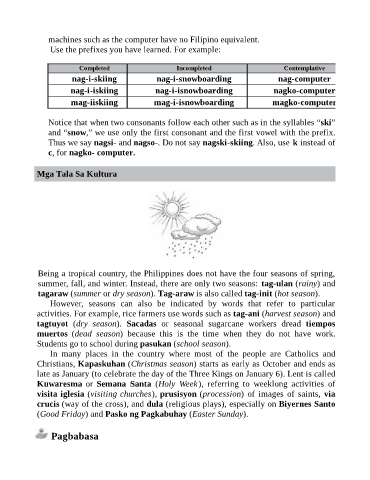
              summer, fall, and winter. Instead, there are only two seasons: tag-ulan (rainy) and
              tagaraw (summer or dry season). Tag-araw is also called tag-init (hot season).
                  However,  seasons  can  also  be  indicated  by  words  that  refer  to  particular
             activities. For example, rice farmers use words such as tag-ani (harvest season) and
             tagtuyot  (dry  season).  Sacadas  or  seasonal  sugarcane  workers  dread  tiempos
             muertos  (dead  season)  because  this  is  the  time  when  they  do  not  have  work.
             Students go to school during pasukan (school season).
                  In  many  places  in  the  country  where  most  of  the  people  are  Catholics  and
             Christians, Kapaskuhan (Christmas season) starts as early as October and ends as
             late as January (to celebrate the day of the Three Kings on January 6). Lent is called
             Kuwaresma or Semana  Santa  (Holy  Week),  referring  to  weeklong  activities  of

             visita iglesia (visiting churches), prusisyon (procession) of images of saints, via
             crucis (way of the cross), and dula (religious plays), especially on Biyernes Santo
             (Good Friday) and Pasko ng Pagkabuhay (Easter Sunday).


                  Pagbabasa

