


Page 253 - Tagalog for Beginners: An Introduction to Filipino, the National Language of the Philippines
P. 253
root word


                     (When the word ends with a vowel, insert an h between the root word and the
                 affix in. This makes you avoid having two vowels together.)


                 Using the ni affix:


                               Completed                       Incompleted                     Contemplative
                                                        first two syllables of
                           in + root word                completed aspect +               first syllable of root
                                                                                         word + root word +
                                                               root word


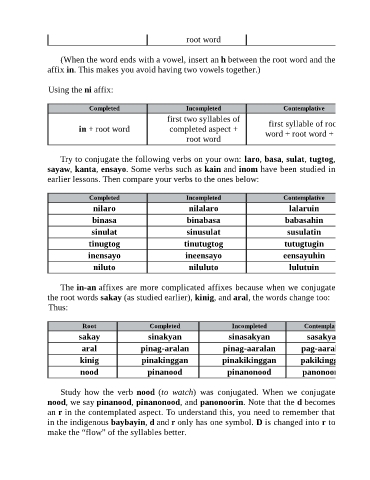
                     Try to conjugate the following verbs on your own: laro, basa, sulat, tugtog,
                 sayaw, kanta, ensayo. Some verbs such as kain and inom have been studied in
                 earlier lessons. Then compare your verbs to the ones below:


                               Completed                       Incompleted                     Contemplative
                                nilaro                         nilalaro                          lalaruin

                                binasa                         binabasa                        babasahin
                               sinulat                         sinusulat                        susulatin

                              tinugtog                        tinutugtog                       tutugtugin
                              inensayo                        ineensayo                        eensayuhin
                                niluto                         niluluto                          lulutuin


                     The in-an affixes are more complicated affixes because when we conjugate
                 the root words sakay (as studied earlier), kinig, and aral, the words change too:
                 Thus:


                            Root                   Completed                  Incompleted             Contemplated
                           sakay                  sinakyan                   sinasakyan                sasakyan
                            aral                pinag-aralan               pinag-aaralan             pag-aaralan

                           kinig                pinakinggan                pinakikinggan            pakikinggan
                            nood                  pinanood                  pinanonood               panonoorin


                     Study  how  the  verb nood (to  watch)  was  conjugated.  When  we  conjugate
                 nood, we say pinanood, pinanonood, and panonoorin. Note that the d becomes
                 an r in the contemplated aspect. To understand this, you need to remember that
                 in the indigenous baybayin, d and r only has one symbol. D is changed into r to
                 make the “flow” of the syllables better.

