


Page 120 - (DK Eyewitness) Travel Guide - Chicago
P. 120
118 CHIC A GO AREA B Y AREA
8 Lower West Side
Bounded by Chicago River, 16th St., &
Pulaski Rd. q 18th. @ 9, 18, 60.
The Lower West Side, like the
Near West Side, developed as
an industrial, working-class
neighborhood after the 1871
fire. Immigrants from Bohemia
were the first to arrive, in the
1870s, followed in the early
20th century by Germans,
Poles, and Yugoslavians. In
the 1950s, an influx of Mexican
and Puerto Rican immigrants
brought a Hispanic flavor to
the community.
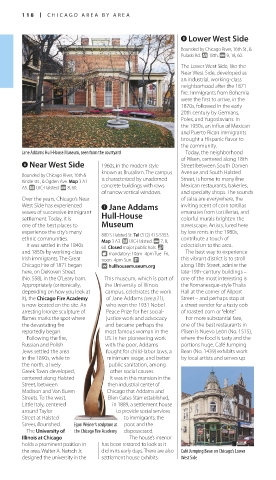
Jane Addams Hull-House Museum, seen from the courtyard Today, the neighborhood
of Pilsen, centered along 18th
6 Near West Side 1960s, in the modern style Street between South Damen
known as Brutalism. The campus Avenue and South Halsted
Bounded by Chicago River, 16th &
Kinzie sts., & Ogden Ave. Map 3 A1– is characterized by unadorned Street, is home to many fine
A5. q UIC-Halsted. @ 8, 60. concrete buildings with rows Mexican restaurants, bakeries,
of narrow vertical windows. and specialty shops. The sounds
Over the years, Chicago’s Near of salsa are everywhere, the
West Side has experienced 7 Jane Addams inviting scent of corn tortillas
waves of successive immigrant Hull-House emanates from tortillerias, and
settlement. Today, it is colorful murals brighten the
one of the best places to Museum streetscape. Artists, lured here
experience the city’s many 800 S Halsted St. Tel (312) 413-5353. by low rents in the 1980s,
ethnic communities. Map 3 A3. q UIC-Halsted. @ 7, 8, contribute a touch of
It was settled in the 1840s 60. Closed major public hols. & eclecticism to the area.
and 1850s by working-class 8 mandatory: 10am–4pm Tue–Fri, The best way to experience
Irish immigrants. The Great noon–4pm Sun. h this vibrant district is to stroll
Chicago Fire of 1871 began ∑ hullhousemuseum.org along 18th Street, admire the
here, on DeKoven Street late-19th-century buildings –
(No. 558), in the O’Leary barn. This museum, which is part of one of the most interesting is
Appropriately (or ironically, the University of Illinois the Romanesque-style Thalia
depending on how you look at campus, celebrates the work Hall at the corner of Allport
it), the Chicago Fire Academy of Jane Addams (see p31), Street – and perhaps stop at
is now located on the site. An who won the 1931 Nobel a street vendor for a tasty cob
arresting bronze sculpture of Peace Prize for her social- of roasted corn or “elote”.
flames marks the spot where justice work and advocacy For more substantial fare,
the devastating fire and became perhaps the one of the best restaurants in
reportedly began. most famous woman in the Pilsen is Nuevo León (No. 1515),
Following the fire, US. In her pioneering work where the food is tasty and the
Russian and Polish with the poor, Addams portions huge. Café Jumping
Jews settled the area fought for child-labor laws, a Bean (No. 1439) exhibits work
in the 1890s, while to minimum wage, and better by local artists and serves up
the north, a lively public sanitation, among
Greek Town developed, other social causes.
centered along Halsted It was in this mansion in the
Street, between then industrial center of
Madison and Van Buren Chicago that Addams and
Streets. To the west, Ellen Gates Starr established,
Little Italy, centered in 1889, a settlement house
around Taylor to provide social services
Street at Halsted to immigrants, the
Street, flourished. Egon Weiner’s sculpture at poor, and the
The University of the Chicago Fire Academy dispossessed.
Illinois at Chicago The house’s interior
holds a prominent position in has been restored to look as it
the area. Walter A. Netsch Jr. did in its early days. There are also Café Jumping Bean on Chicago’s Lower
designed the university in the settlement house exhibits. West Side
118-119_EW_Chicago.indd 118 13/07/16 2:56 pm

