


Page 53 - (DK Eyewitness) Travel Guide - Chicago
P. 53
AR T INSTITUTE OF CHIC A GO 51
fragments of Coptic cloth precursor of
dating from between the all abstract art
5th and 8th centuries. forms; German
Two of the quirkiest – and Expressionism, the
most renowned – collections embodiment of
are the Arthur Rubloff Paper- the search for a
weight Collection and the strong emotional
Thorne Miniature Rooms. The language in art;
museum’s holdings of more and Surrealism, the
than 1,000 French, English, and liberation of
American glass paperweights, the irrational.
popular in the mid-19th Post-World War II
century, are one of the art is also well-
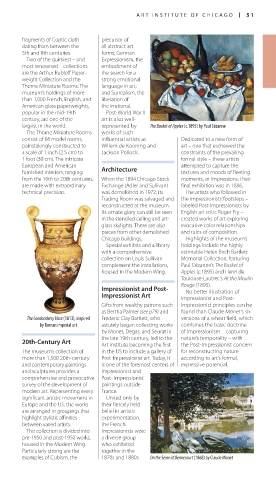
largest in the world. represented by The Basket of Apples (c.1895) by Paul Cézanne
The Thorne Miniature Rooms works of such
consist of 68 model rooms, influential artists as Dedicated to a new form of
painstakingly constructed to Willem de Kooning and art – one that eschewed the
a scale of 1 inch (2.5 cm) to Jackson Pollock. constraints of the prevailing
1 foot (30 cm). The intricate formal style – these artists
European and American attempted to capture the
furnished interiors, ranging Architecture textures and moods of fleeting
from the 16th to 20th centuries, When the 1894 Chicago Stock moments, or impressions. Their
are made with extraordinary Exchange (Adler and Sullivan) final exhibition was in 1886.
technical precision. was demolished in 1972, its The artists who followed in
Trading Room was salvaged and the Impressionists’ footsteps –
reconstructed at the museum. labeled Post-Impressionists by
Its ornate glory can still be seen English art critic Roger Fry –
in the stenciled ceiling and art- created works of art exploring
glass skylights. There are also evocative color relationships
pieces from other demolished and rules of composition.
Chicago buildings. Highlights of the museum’s
Special exhibits and a library holdings include the highly
with a comprehensive estimable Helen Birch Bartlett
collection on Louis Sullivan Memorial Collection, featuring
complement the installations, Paul Cézanne’s The Basket of
housed in the Modern Wing. Apples (c.1895) and Henri de
Toulouse-Lautrec’s At the Moulin
Rouge (1895).
Impressionist and Post- No better illustration of
Impressionist Art
Impressionist and Post-
Gifts from wealthy patrons such Impressionist principles can be
as Bertha Palmer (see p79) and found than Claude Monet’s six
The Londonderry Vase (1813), inspired Frederic Clay Bartlett, who versions of a wheat field, which
by Roman imperial art astutely began collecting works combines the basic doctrine
by Monet, Degas, and Seurat in of Impressionism – capturing
the late 19th century, led to the nature’s temporality – with
20th-Century Art Art Institute becoming the first the Post-Impressionist concern
The museum’s collection of in the US to include a gallery of for reconstructing nature
more than 1,500 20th-century Post-Impressionist art. Today, it according to art’s formal,
and contemporary paintings is one of the foremost centers of expressive potential.
and sculptures provides a Impressionist and
comprehensive and provocative Post- Impressionist
survey of the development of paintings outside
modern art. Representing every France.
significant artistic movement in United only by
Europe and the US, the works their fiercely held
are arranged in groupings that belief in artistic
highlight stylistic affinities experimentation,
between varied artists. the French
The collection is divided into Impressionists were
pre-1950 and post-1950 works, a diverse group
housed in the Modern Wing. who exhibited
Particularly strong are the together in the
examples of Cubism, the 1870s and 1880s. On the Seine at Bennecourt (1868) by Claude Monet
050-051_EW_Chicago.indd 51 13/07/16 2:59 pm

