


Page 99 - (DK Eyewitness) Travel Guide - Chicago
P. 99
SOUTH L OOP AND NEAR SOUTH SIDE 97
There are two complexes has been set for its reopening
of note. The McCormick to the public.
Tribune Campus Center,
designed by Rem Koolhaas, p Calumet-Giles-
features a sound-buffering,
concrete and steel tube that Prairie District
encloses the “L” tracks passing Calumet to Prairie aves, from
directly over the building. 31st to 35th sts. Map 6 D4.
A residence hall complex q 35-Bronzeville-IIT.
designed by Helmut Jahn
consists of terrace-topped This small enclave of restored
buildings joined by glass walls Victorian houses was granted
that muffle train noise. A map national landmark status in
of the campus is available from 1980. Of particular interest is
Hermann Union Hall. Joseph Deimel House (3141
South Calumet Avenue),
o Pilgrim Baptist designed in 1887 by Adler and
Sullivan and the only remaining
Church residential commission by the
firm in this area.
3301 S Indiana Ave. Map 6 D4. Office.
q 35-Bronzeville-IIT. Closed until The Joliet limestone row Ida B. Wells-Barnett House
further notice. houses (3144–8 South Calumet a Ida B. Wells-
Avenue), built in 1881, are a
This landmark building fine example of Victorian Barnett House
was built in 1890–91 and row-house architecture. 3624 S King Dr. Map 6 E5.
designed by Adler and However, only three of q 35-Bronzeville-IIT.
Sullivan for Chicago’s oldest the original eight houses Closed to public.
Jewish con gregation, are still standing.
Kehilath Anshe Ma’ariv. It A block to the south are the Civil rights and women’s
then became the Pilgrim only row houses Frank Lloyd suffrage advocate Ida B. Wells
Baptist Church from Wright designed (1894) – (1862–1931) lived in this house
1926 until January the Robert W. Roloson with her husband from 1919 to
2006 when it was Houses (3213–19 South 1930. Born a slave in Mississippi,
destroyed by fire. Calumet Avenue). Wells became a teacher at age
The magnificent Like Robie House (see 14 but was dismissed for
arched doorway was pp104–105), Wright used protesting segregation.
the only surviving Roman bricks for the Wells’ work as a columnist for
example of an walls, here decorated Memphis Free Speech brought
ecclesiastical arch by with terra-cotta panels her to Chicago in 1893 to report
Adler and Sullivan and between the upper- on the lack of African-American
reflected the strong story windows. repre sentation at the World’s
masonry forms of A trio of Columbian Exposition. She
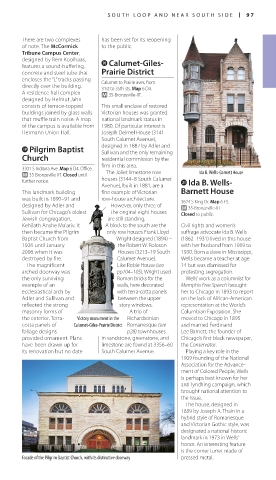
the exterior. Terra- Victory monument in the Richardsonian moved to Chicago in 1895
cotta panels of Calumet-Giles-Prairie District Romanesque (see and married Ferdinand
foliage designs p28) townhouses Lee Barnett, the founder of
provided ornament. Plans in sandstone, greenstone, and Chicago’s first black newspaper,
have been drawn up for limestone are found at 3356–60 the Conservator.
its renovation but no date South Calumet Avenue. Playing a key role in the
1909 founding of the National
Association for the Advance-
ment of Colored People, Wells
is perhaps best known for her
anti-lynching campaign, which
brought national attention to
the issue.
The house, designed in
1889 by Joseph A. Thain in a
hybrid style of Romanesque
and Victorian Gothic style, was
designated a national historic
landmark in 1973 in Wells’
honor. An interesting feature
is the corner turret made of
Facade of the Pilgrim Baptist Church, with its distinctive doorway pressed metal.
096-097_EW_Chicago.indd 97 13/07/16 2:59 pm

